Water Sort Strategy for Hard Levels: Think Like a Solver
Hard water sort levels need more than quick pours. Learn advanced strategies: working backwards, parking colours, counting layers and recovering from dead ends.
- Why hard levels need planning several pours ahead
- Advanced techniques like parking and sequencing
- How to recover from a dead end without restarting
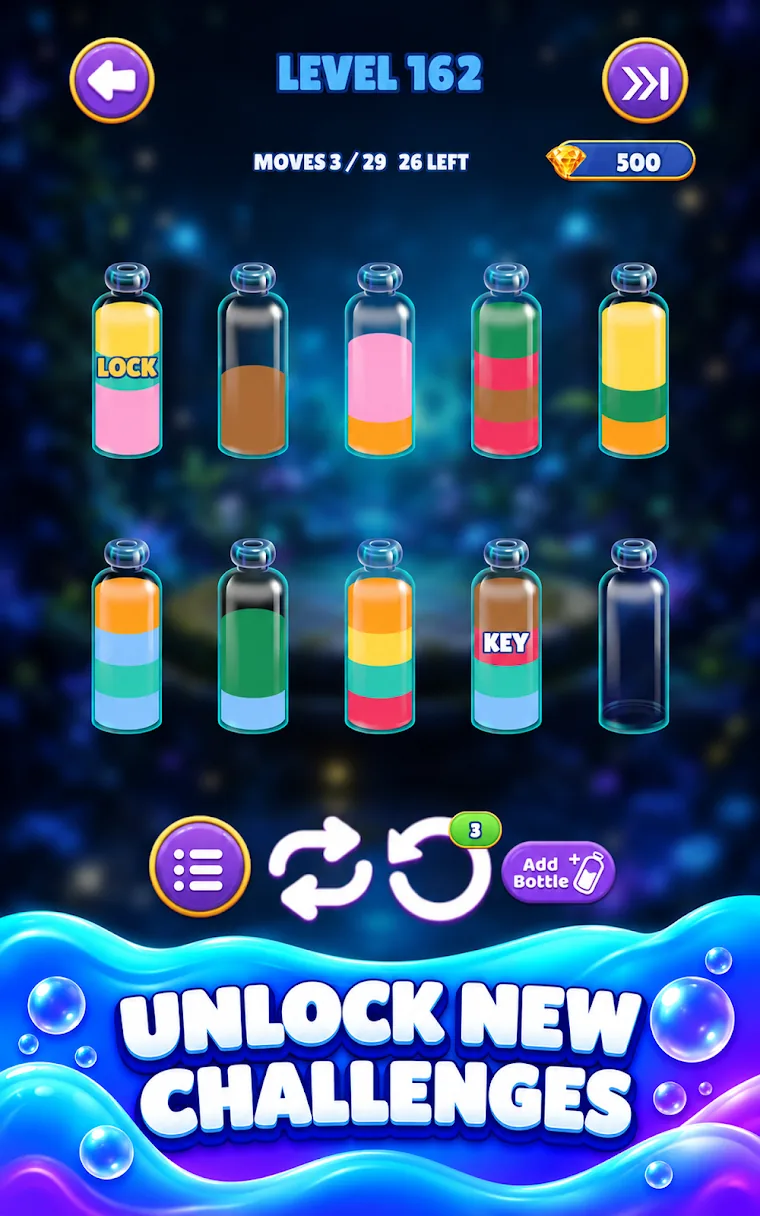
Early water sort levels can be solved by instinct. Later levels, with more colours, fuller bottles and fewer empty spaces, need real planning. These strategies will help you think like an experienced solver.
What makes a level hard?
- More colours than empty bottles.
- Fewer empty bottles to work with.
- Colours buried deep under several layers.
- Special bottles that limit what you can do (see special bottles explained).
- Move limits (see limited-moves strategy).
Technique 1: Map the colours
Before pouring, count how many layers of each colour are visible and where they are. Note which colours are mostly at the bottom of bottles: those bottles are good "bases" to build on.
Technique 2: Choose your base bottles
A base bottle has the same colour at the bottom. Building on bases means fewer pours later.
Technique 3: Park, don't scatter
When you need to move a layer out of the way, "park" it on a bottle where it matches, not in an empty bottle, unless that empty bottle will become that colour's home.
Technique 4: Sequence your pours
Some pours only become possible after others. Think in sequences: "If I pour A onto B, then C becomes free, then I can complete D."
Technique 5: Work backwards
Picture the solved state. Which colour will be easiest to finish first? What has to move to make that happen? Work backwards from that goal.
Technique 6: Recover with undo
If you reach a dead end, undo several steps to the last point where you had an empty bottle, and try a different sequence.
A routine for hard levels
- Count colours and empty bottles.
- Pick one colour to complete first, ideally one with a base bottle.
- Plan the sequence of pours to gather it.
- Park blocking layers on matching tops.
- Complete the colour, then re-assess.
- Undo to the last empty bottle if you hit a dead end.
When to use help
Hints and the extra bottle are most valuable on hard levels. Use a hint to reveal one move, then continue on your own. Color Flow offers hints, multi-step undo, restart and an extra bottle when available. Read water sort hints and undo for when to use each.
Key takeaways
- Hard levels have more colours, fewer empty bottles and special twists.
- Map colours, choose base bottles and park layers on matching tops.
- Plan sequences and work backwards from a completed colour.
- Undo to your last empty bottle instead of restarting.
Frequently asked questions
How do you beat hard water sort levels?
Plan several pours ahead, build on base bottles, keep empty bottles free and use undo to recover from dead ends.
Are all water sort levels solvable?
Well-designed levels have a solution. If stuck, undo further back or use a hint.
What is a base bottle?
A bottle with one colour at the bottom that you build on to complete that colour.
Should I restart or undo when stuck?
Undo first, back to the last point where you had an empty bottle. Restart only if that doesn't help.

We're an independent app studio in Pune, India. We build Color Flow - Water Sort Puzzle and write these guides from what we learn making it and from the questions our users send us. Spotted an error? Email qunovixtechnologies@gmail.com.