How Much Do You Need to Retire in India? A Step-by-Step Calculation
Work out your retirement corpus in India step by step: future expenses with inflation, the corpus you need, and the monthly SIP required, with a worked example.
- How inflation changes your future expenses
- How to estimate the retirement corpus you need
- How much to invest each month to get there
Retirement can feel far away, but the earlier you plan, the less you need to save each month. The calculation isn't complicated. It just needs a few honest assumptions.
This guide uses simplified assumptions for illustration. It isn't financial advice. Consider speaking with a SEBI-registered investment adviser for a personal plan.
Step 1: Know today's monthly expenses
Start with what you spend now, excluding costs that will disappear by retirement (like home loan EMIs or children's school fees) and adding ones that may grow (like healthcare).
Example: ₹50,000 a month.
Step 2: Adjust for inflation
Prices rise every year. To estimate expenses at retirement:
Future expense = today's expense × (1 + inflation)ʸᵉᵃʳˢ
With 6% inflation over 25 years: ₹50,000 × (1.06)²⁵ ≈ ₹2,14,600 a month, or about ₹25.75 lakh a year.
That's the same lifestyle, just at future prices.
Step 3: Estimate the corpus you need
A simple approach is to multiply your first-year retirement expenses by a factor. Common rules of thumb use 25 to 33 times annual expenses, depending on how long retirement lasts and what returns you expect after retiring.
| Multiple | Corpus (₹25.75 lakh/year) |
|---|---|
| 25× | About ₹6.4 crore |
| 30× | About ₹7.7 crore |
The higher multiple gives more safety, especially for early retirement or longer life expectancy. Indian retirees may also want a buffer for healthcare costs.
Step 4: Subtract what you already have
Add up existing retirement savings: EPF, PPF, NPS, mutual funds and other investments. Estimate what they'll grow to by retirement and subtract it from your target.
Step 5: Calculate the monthly investment
Use a SIP calculator to find the monthly amount needed to cover the gap. Increasing your SIP each year with your income (a step-up SIP) makes a large target more achievable.
How to plan your retirement corpus
- List today's monthly expenses. Adjust for what will change in retirement.
- Apply inflation. Use 6% or higher for a conservative estimate.
- Multiply by 25–33. That's your target corpus.
- Value your current savings. Project EPF, PPF, NPS and investments forward.
- Find the gap. Target minus projected savings.
- Set a monthly SIP. And increase it yearly.
- Review every year. Update expenses, returns and progress.
Where retirement money usually comes from in India
| Source | Notes |
|---|---|
| EPF | Mandatory for many salaried employees; long-term, government-administered |
| PPF | 15-year, tax-free, government-backed (see PPF interest calculation) |
| NPS | Market-linked pension scheme with part withdrawal and part annuity at retirement |
| Mutual funds | Equity for growth, debt for stability, via SIPs |
| SCSS and post office schemes | Regular income after 60 (see post office savings schemes) |
Don't forget
- Health insurance: medical costs are one of the biggest risks in retirement.
- Emergency fund: so you don't dip into retirement savings early.
- Longevity: plan for a long retirement, not an average one.
- Inflation after retirement: expenses keep rising, so your corpus must keep growing.
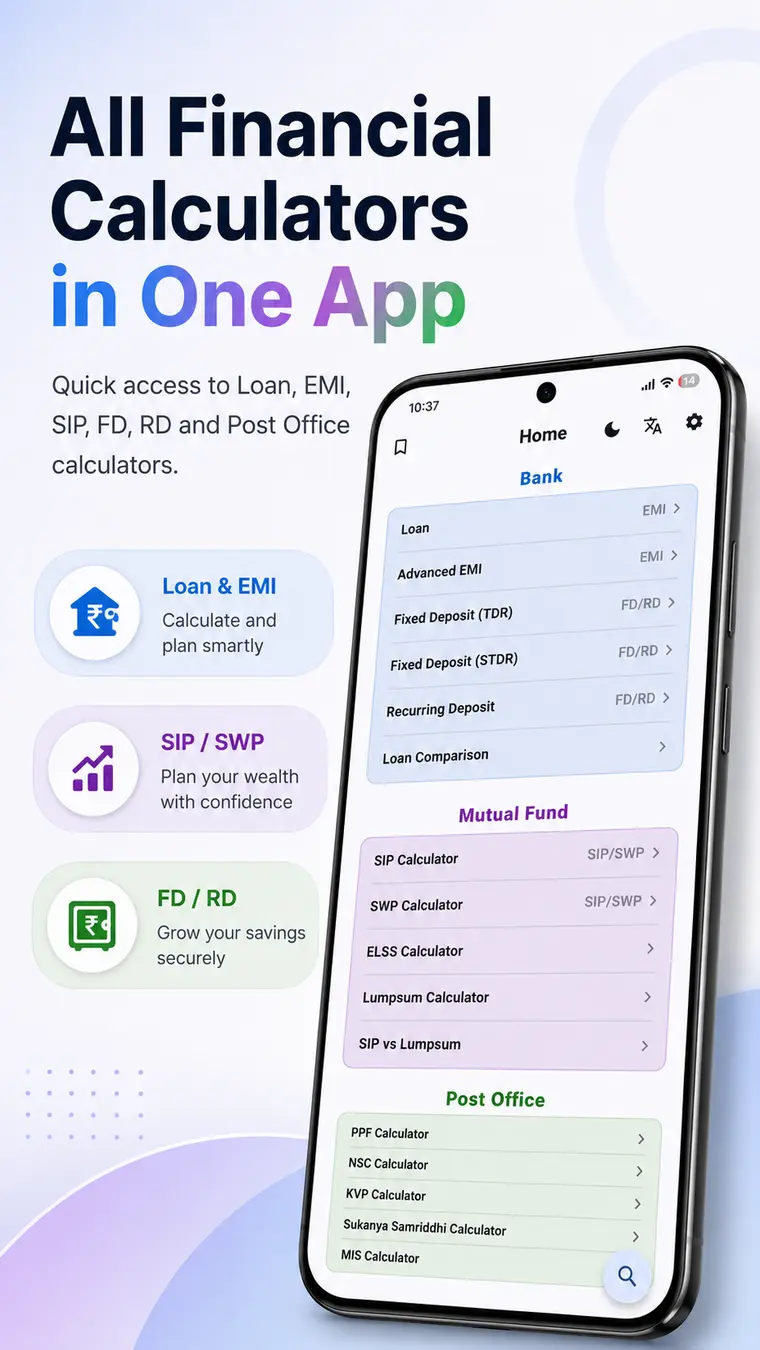
FinCalc India includes retirement, SIP, step-up SIP, PPF and NPS-style calculators so you can try different assumptions quickly.
Key takeaways
- Inflation can roughly quadruple expenses over 25 years at 6%.
- A common target is 25–33 times your first year's retirement expenses.
- Subtract existing savings, then calculate the monthly SIP to fill the gap.
- Step up your SIP each year and review your plan annually.
Frequently asked questions
How much money do I need to retire in India?
It depends on your expenses, inflation and years to retirement. A common starting estimate is 25–33 times your annual expenses at retirement.
What inflation rate should I assume for retirement?
Many planners use around 6% for general expenses and higher for healthcare. Using a slightly higher rate is more conservative.
Is EPF enough for retirement?
For many people, EPF alone isn't enough. It's a good base, usually combined with PPF, NPS and mutual funds.
When should I start retirement planning?
As early as possible. Starting ten years earlier can dramatically reduce the monthly amount needed.

We're an independent app studio in Pune, India. We build Finance Calculator: EMI & SIP and write these guides from what we learn making it and from the questions our users send us. Spotted an error? Email qunovixtechnologies@gmail.com.