EMI Calculation Formula Explained (With Home, Car and Personal Loan Examples)
Learn how EMI is calculated in India with the standard formula, worked home, car and personal loan examples, and how interest and principal change.
- The EMI formula banks use, explained in plain English
- Worked examples for home, car and personal loans
- Why most of your early EMIs go towards interest
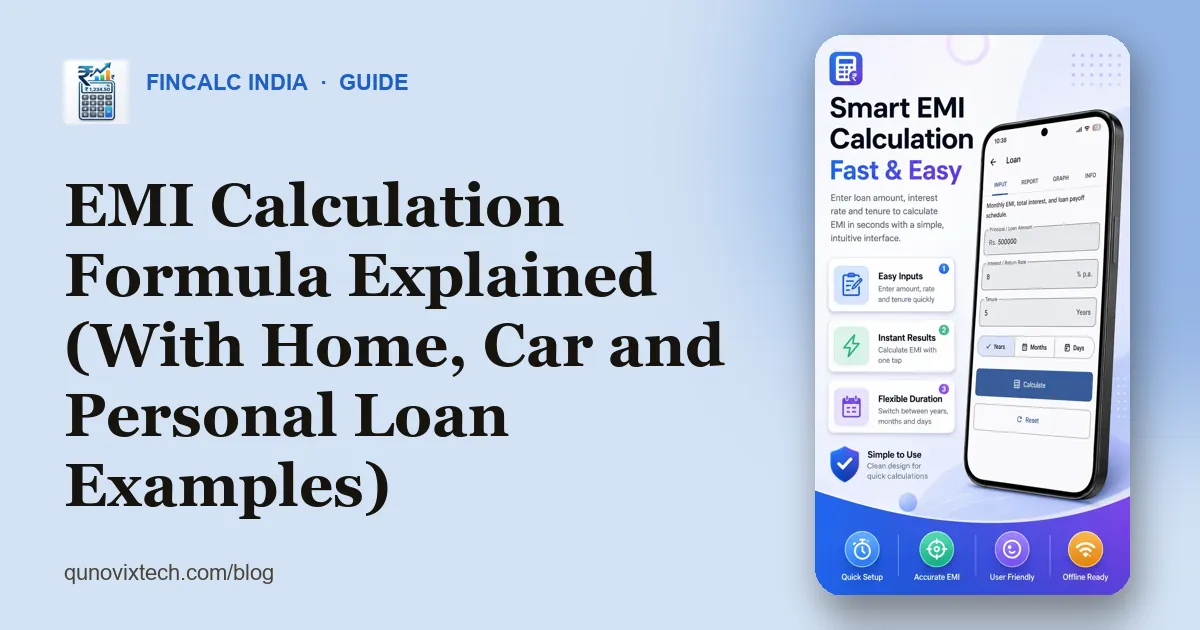
An EMI (Equated Monthly Instalment) is the fixed amount you pay every month to repay a loan. Banks calculate it using a standard formula. Understanding it helps you compare loans, choose a tenure and see how much interest you'll really pay.
This guide is for general information only and isn't financial advice. Always check the exact terms with your lender.
The EMI formula
EMI = P × r × (1 + r)ⁿ ÷ [(1 + r)ⁿ − 1]
Where:
- P = loan amount (principal)
- r = monthly interest rate = annual rate ÷ 12 ÷ 100
- n = number of monthly instalments (tenure in months)
How to calculate EMI step by step
- Write down the loan amount. For example, ₹25,00,000.
- Convert the annual rate to a monthly rate. 8.5% ÷ 12 ÷ 100 = 0.0070833.
- Convert tenure to months. 20 years × 12 = 240 months.
- Calculate (1 + r)ⁿ. (1.0070833)²⁴⁰ ≈ 5.441.
- Apply the formula. 25,00,000 × 0.0070833 × 5.441 ÷ 4.441 ≈ ₹21,696 a month.
Worked examples
| Loan | Amount | Rate | Tenure | EMI | Total interest |
|---|---|---|---|---|---|
| Home loan | ₹25,00,000 | 8.5% | 20 years | ₹21,696 | ₹27,06,939 |
| Home loan | ₹30,00,000 | 9% | 20 years | ₹26,992 | ₹34,78,027 |
| Home loan | ₹30,00,000 | 9% | 15 years | ₹30,428 | ₹24,77,040 |
| Car loan | ₹5,00,000 | 10.5% | 5 years | ₹10,747 | ₹1,44,817 |
| Personal loan | ₹10,00,000 | 11% | 5 years | ₹21,742 | ₹3,04,545 |
Rates are examples only. Actual rates depend on your lender, credit score and loan type.
Notice the tenure effect: on the ₹30 lakh loan, choosing 15 years instead of 20 raises the EMI by about ₹3,400 a month but cuts total interest by roughly ₹10 lakh.
Why early EMIs are mostly interest
Each month, interest is charged on the outstanding balance. Early in the loan the balance is high, so most of your EMI goes to interest and only a little reduces the principal. Over time this flips.
| Year | Interest share of EMI (₹25 lakh, 8.5%, 20 years) |
|---|---|
| Year 1 | Roughly 80% |
| Year 10 | Roughly 60% |
| Year 20 | Small |
This is why prepaying a home loan early in the tenure saves the most interest.
Factors that change your EMI
- Loan amount: a bigger loan means a bigger EMI.
- Interest rate: even 0.5% makes a real difference over 20 years.
- Tenure: longer tenure lowers EMI but increases total interest.
- Floating vs fixed rate: floating-rate EMIs (or tenures) can change when your bank's benchmark rate changes.
Floating rates: EMI or tenure?
When rates change on a floating loan, many banks adjust the tenure first and keep the EMI the same. Check your loan statement after any rate change to see whether your tenure has increased, and ask your bank about your options.
How much EMI can you afford?
A common rule of thumb is to keep total EMIs within about 40% of your take-home pay, leaving room for living costs, savings and emergencies. Lenders have their own limits too.
Use an EMI calculator
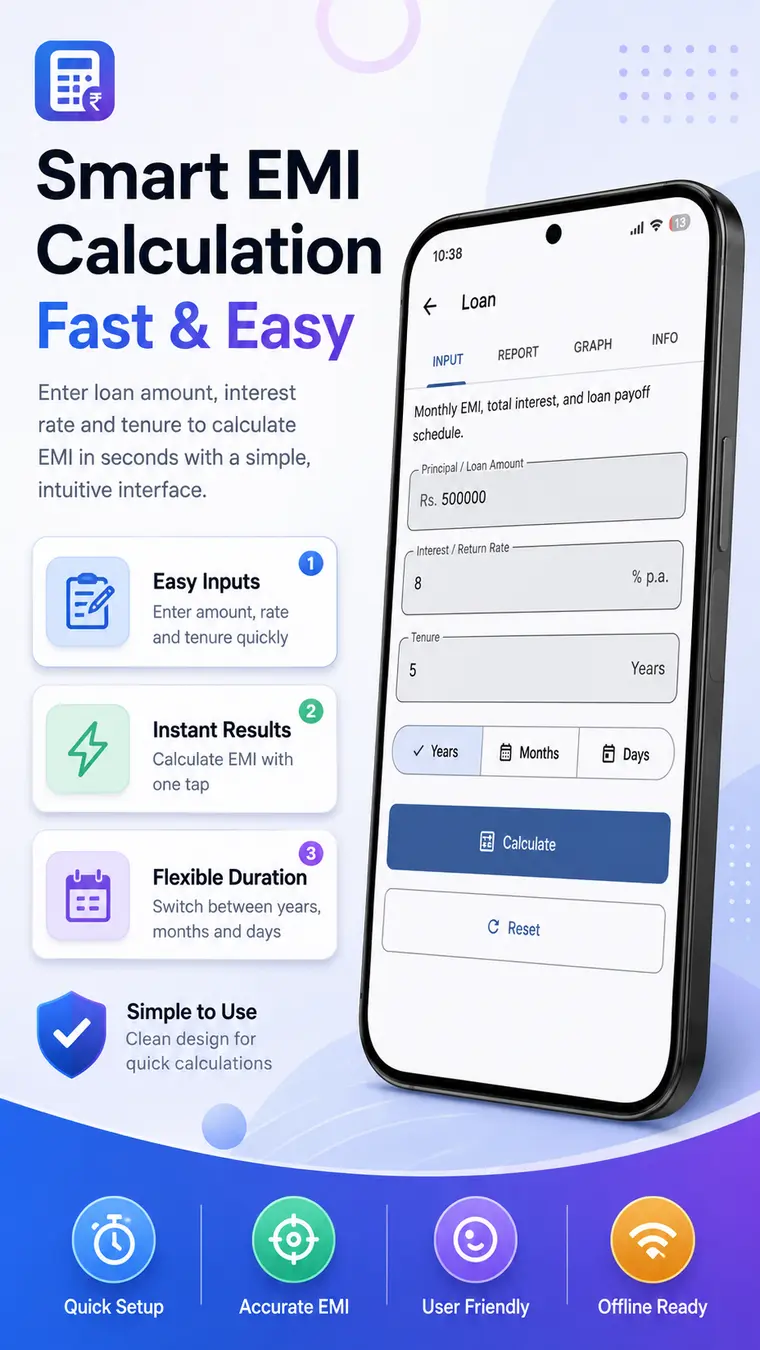
The formula is easy with a calculator, but an app is faster and shows the full amortisation schedule. FinCalc India includes EMI, advanced EMI, loan comparison and prepayment calculators, with charts and a month-by-month table.
Key takeaways
- EMI = P × r × (1 + r)ⁿ ÷ [(1 + r)ⁿ − 1], using a monthly rate and tenure in months.
- Longer tenures lower EMI but greatly increase total interest.
- Early EMIs are mostly interest, so early prepayments save the most.
- Keep total EMIs within a comfortable share of your take-home pay.
Frequently asked questions
How is EMI calculated in India?
Banks use the formula EMI = P × r × (1 + r)ⁿ ÷ [(1 + r)ⁿ − 1], where r is the monthly rate and n the number of months.
What is the EMI for a ₹25 lakh home loan?
At 8.5% for 20 years, the EMI is about ₹21,696. It changes with the interest rate and tenure.
Is it better to choose a shorter loan tenure?
A shorter tenure means a higher EMI but much less total interest. Choose the shortest tenure with an EMI you can comfortably afford.
Does EMI change with a floating interest rate?
It can. Many banks change the tenure first when rates move, but some change the EMI. Check with your lender.

We're an independent app studio in Pune, India. We build Finance Calculator: EMI & SIP and write these guides from what we learn making it and from the questions our users send us. Spotted an error? Email qunovixtechnologies@gmail.com.