How to Calculate BMI: Formula and Examples (kg, lbs and Stones)
Learn how to calculate BMI by hand using metric or imperial units, with worked examples in kilograms, pounds and stones, plus what your result means.
- The BMI formula for metric and imperial units
- Step-by-step worked examples you can follow
- How to interpret your result and its limits
Body Mass Index (BMI) is one of the most widely used screening measures for weight. It's simple to calculate with a calculator, or a few seconds in an app. Here's exactly how it works.
The BMI formula
Metric (kilograms and metres)
BMI = weight (kg) ÷ height (m)²
Imperial (pounds and inches)
BMI = weight (lb) × 703 ÷ height (in)²
The 703 converts imperial units so the result matches the metric scale.
How to calculate BMI in metric units
- Measure your weight in kilograms. For example, 70 kg.
- Convert your height to metres. 175 cm = 1.75 m.
- Square your height. 1.75 × 1.75 = 3.0625.
- Divide your weight by the squared height. 70 ÷ 3.0625 = 22.86.
- Round to one decimal place. Your BMI is 22.9.
Worked example in pounds and inches
Someone who weighs 154 lb and is 5 ft 9 in tall:
- Height in inches: (5 × 12) + 9 = 69 in
- Height squared: 69 × 69 = 4,761
- Weight × 703: 154 × 703 = 108,262
- BMI: 108,262 ÷ 4,761 = 22.7
Worked example in stones and pounds
In the UK, weight is often given in stones. One stone is 14 lb.
- 11 st 0 lb = (11 × 14) + 0 = 154 lb
- Then use the imperial formula as above.
For more on this, see our guide to BMI in stones and pounds.
What does your BMI mean?
For adults, the World Health Organization uses these categories:
| BMI | Category |
|---|---|
| Below 18.5 | Underweight |
| 18.5–24.9 | Healthy weight |
| 25.0–29.9 | Overweight |
| 30.0 and above | Obesity |
Our BMI chart for adults breaks these down further, including the different obesity classes. If you're of South Asian, Chinese or other Asian background, lower thresholds are often recommended. See BMI for Indians and Asians.
Calculate the healthy weight range for your height
You can rearrange the formula to find your healthy weight range:
Weight = BMI × height (m)²
For someone 1.75 m tall: - Lower end: 18.5 × 3.0625 = 56.7 kg - Upper end: 24.9 × 3.0625 = 76.3 kg
Our healthy weight for height chart lists ranges for common heights.
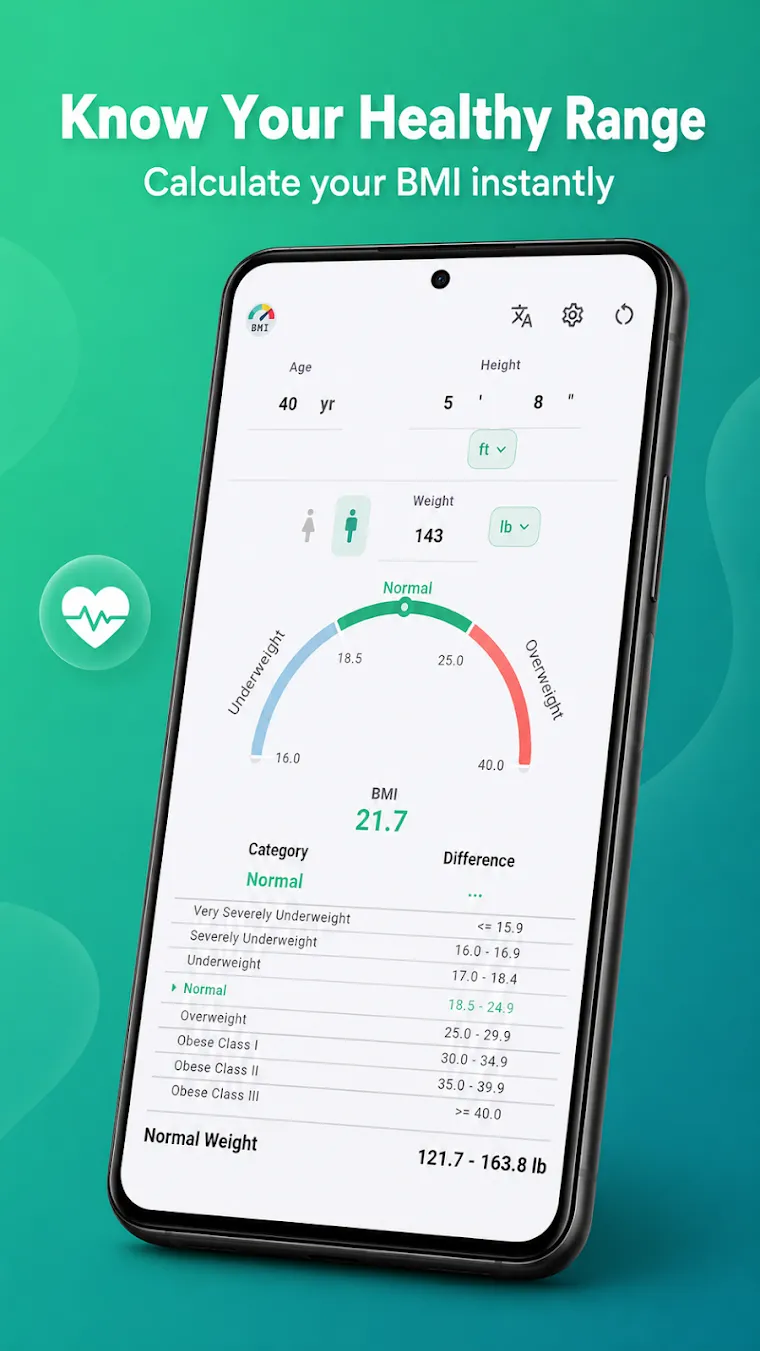
Use a calculator to skip the maths
BMI Calculator shows your BMI on a colour-coded gauge as you enter your height and weight in metric, imperial or stones. It also shows your healthy weight range and how far you are from it.
Remember BMI's limits
BMI doesn't measure body fat directly and doesn't account for muscle, bone density, age or fat distribution. It's a useful starting point, not a diagnosis. Read is BMI accurate? to understand when it can mislead.
BMI categories for adults don't apply to children and teenagers. See BMI for children.
Key takeaways
- Metric: BMI = weight (kg) ÷ height (m)².
- Imperial: BMI = weight (lb) × 703 ÷ height (in)².
- 18.5–24.9 is the WHO healthy range for adults. Lower cut-offs are often used for Asian populations.
- BMI is a screening tool, not a full picture of health.
Frequently asked questions
How do I calculate my BMI?
Divide your weight in kilograms by your height in metres squared. In imperial units, multiply your weight in pounds by 703 and divide by your height in inches squared.
What is a normal BMI?
For most adults, the WHO considers 18.5 to 24.9 a healthy range.
Is BMI the same for men and women?
Adult BMI categories are the same for men and women, although body fat at the same BMI usually differs between them.
Does BMI change with age?
The standard adult categories don't change with age, but some guidelines use age-adjusted ranges for older adults. Children use age- and sex-specific percentiles.

We're an independent app studio in Pune, India. We build BMI Calculator and write these guides from what we learn making it and from the questions our users send us. Spotted an error? Email qunovixtechnologies@gmail.com.