How to Start a Journal: A Simple Guide for Beginners
Want to start journaling but don't know where to begin? Learn how to start a journal, what to write, how long to write and how to keep the habit going.
- Why most new journals get abandoned in the first week
- A five-step way to start that actually sticks
- What to write on day one, and what to do when you miss a day
Starting a journal sounds simple. You open a notebook or an app, you write, and that's it. Yet most people who start a journal stop within a couple of weeks. They don't stop because journaling doesn't work. They stop because they set it up in a way that's hard to keep going.
This guide shows you how to start a journal in a way that suits real life: busy days, tired evenings and the occasional week when you forget all about it.
Why most journals get abandoned
Before you write a word, it helps to know what usually goes wrong:
- The bar is too high. People expect every entry to be thoughtful, long and well written. After two or three "perfect" entries, the pressure builds and writing starts to feel like homework.
- There's no fixed time. "I'll write when I feel like it" rarely survives a busy week.
- The blank page is intimidating. Not knowing what to write is the single most common reason people give up.
- Privacy worries. If you're not sure who might read your diary, you won't write honestly, and an entry that isn't honest feels pointless.
Every step below is designed to remove one of these problems.
How to start a journal in 5 steps
- Pick one place to write. Choose either a paper notebook or one journaling app, not both. Splitting entries across places makes it harder to look back and easier to forget.
- Choose a small, fixed moment. Attach journaling to something you already do every day, such as after dinner, before bed or with your morning tea. A consistent cue matters more than the time of day.
- Set a tiny minimum. Commit to three sentences or two minutes. You can always write more, but the minimum is what keeps the streak alive on hard days.
- Use a starter question. Instead of facing a blank page, begin with the same simple prompt every time, such as "What stood out today?"
- Make it private. Keep your notebook somewhere safe or use an app with a lock, so you can be completely honest.
What to write in your first entry
Your first entry doesn't need to be profound. Try one of these:
- Why you're starting a journal and what you hope to get out of it.
- A snapshot of your life right now: where you live, what you do all day, who you spend time with. In a year this will be surprisingly interesting to read.
- Three things that happened today, one thing you're looking forward to and one thing that's bothering you.
If you're still stuck, our list of journal prompts for beginners has 60 questions sorted by mood and situation.
How long should a journal entry be?
There is no right length. Some days you'll write a page. Other days you'll write one line, and that's fine. What matters is that you show up regularly.
A helpful rule is to write until you've said the one thing that's on your mind, then stop. Many people find that a short entry most days beats a long entry once a month, because regular entries build a record you can actually learn from.
Paper or app?
Both work. Paper feels personal and keeps you away from screens. An app is always in your pocket, can be locked, is searchable and can be backed up so you never lose years of writing. If you're unsure, read our comparison of digital vs paper journals.
If you choose an app, look for three things:
- A lock. A PIN, pattern or fingerprint stops anyone who picks up your phone from reading your entries.
- Offline writing. You shouldn't need an internet connection to write.
- Backup you control. Your entries should stay on your device by default, with an optional backup so a lost or broken phone doesn't mean a lost diary.
Different styles of journaling to try
Once the basic habit is in place, you can experiment with styles:
| Style | What it looks like | Good for |
|---|---|---|
| Daily log | A few lines about what happened today | Building the habit, remembering your life |
| Free writing | Write without stopping for 5–10 minutes | Clearing a busy mind |
| Mood journal | Rate your mood and note what affected it | Spotting patterns in how you feel |
| Gratitude journal | Note three specific good things | Ending the day on a calmer note |
| Prompt journal | Answer one question each day | Self-reflection when you're short of ideas |
You don't have to pick one forever. Many people mix them depending on the day. If you want to understand your moods better, our guide to keeping a mood journal is a good next step.
What to do when you miss a day
You will miss days. Everyone does. The mistake is treating a missed day as a failure and quietly giving up.
Instead, follow the "never miss twice" rule: if you skip a day, make the next entry a priority, even if it's one sentence. You can also write a short entry for a day you missed. Many journaling apps let you choose the date of an entry, so you can backfill yesterday while you still remember it.
Make it easier to come back
A few small things make journaling more inviting:
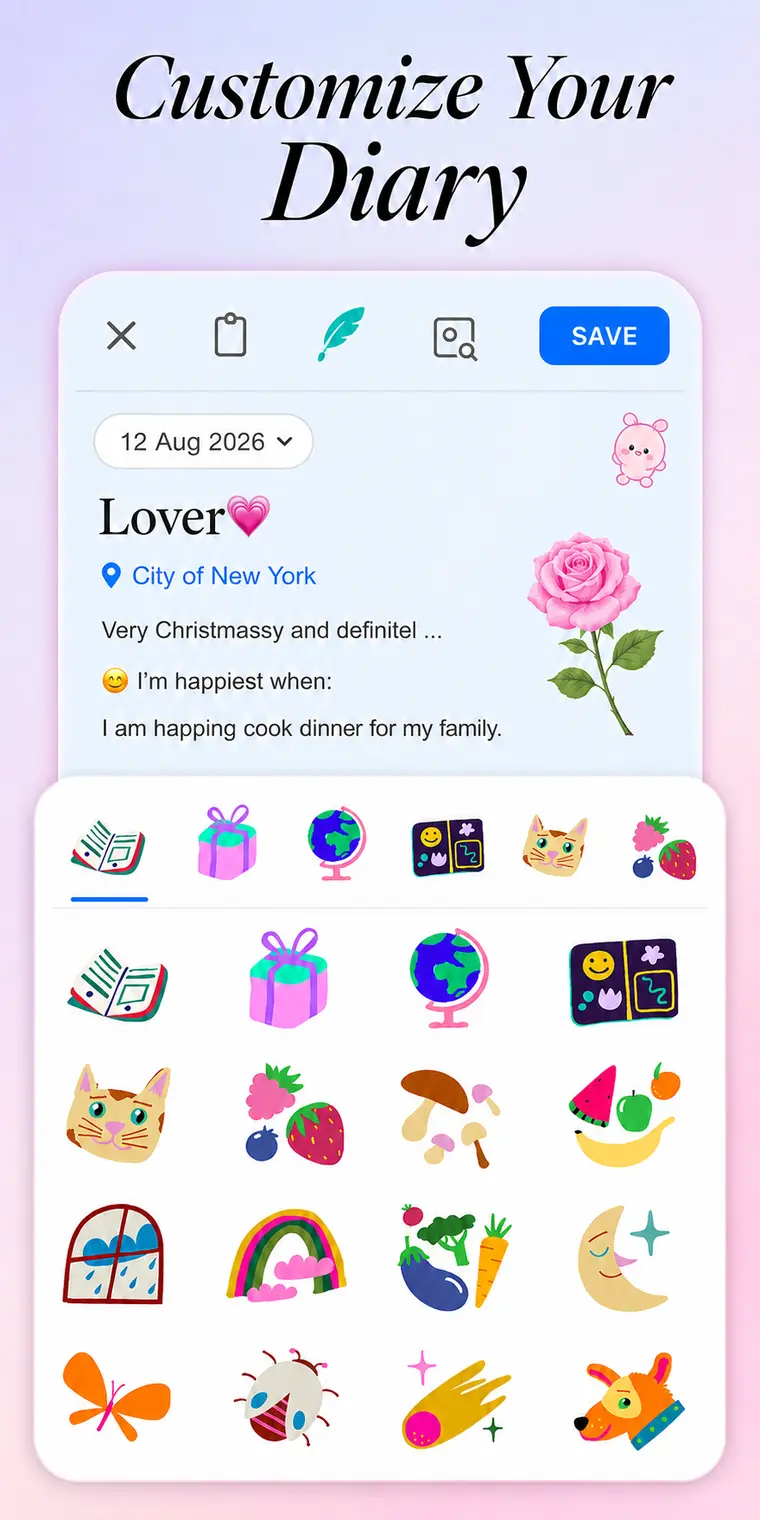
- Make it look like yours. Choose a notebook you like or customise your app's background and theme.
- Re-read old entries occasionally. Seeing how much has changed in a month is one of the most motivating parts of keeping a diary.
- Add more than words. A photo, a sticker, a quick drawing or a mood tag can capture a day faster than a paragraph.
Key takeaways
- Start small: three sentences or two minutes a day is enough.
- Attach journaling to something you already do daily.
- Use a simple starter question so you never face a blank page.
- Keep your journal private so you can write honestly.
- When you miss a day, write the next day, and never miss twice.
Frequently asked questions
What should I write in my journal every day?
Start with what happened, how you felt about it and what you're thinking about tomorrow. If that feels repetitive, answer one prompt per day instead.
Is it better to journal in the morning or at night?
Either works. Morning journaling helps you plan and set intentions. Evening journaling helps you process the day and wind down. Pick the time you can stick to most easily.
How do I keep my journal private?
Store a paper journal somewhere only you can reach. If you use an app, choose one with a PIN, pattern or fingerprint lock, and keep backups in an account only you can access.
Can journaling help with stress?
Many people find that writing down their thoughts helps them feel calmer and more organised. Research on expressive writing suggests it can help some people process difficult experiences. If you're struggling with your mental health, a journal is a helpful companion, but not a replacement for talking to a professional.

We're an independent app studio in Pune, India. We build My Diary: Daily Journal & Lock and write these guides from what we learn making it and from the questions our users send us. Spotted an error? Email qunovixtechnologies@gmail.com.