How Your Habits Affect Your Mood (and How to Find the Links)
Sleep, movement, sunlight and screens can all shape how you feel. Learn which habits are linked with mood and how to track both to find your personal patterns.
- Which everyday habits are commonly linked with mood
- How to track mood and habits together
- How to run simple experiments to see what helps you
Some days feel lighter than others, and the reasons aren't always obvious. Often, small habits like sleep, movement and time outside play a bigger role than we realise. Tracking mood alongside habits helps you find your own patterns.
Habits commonly linked with mood
Research has linked several everyday behaviours with mood and wellbeing:
| Habit | What's commonly observed |
|---|---|
| Sleep | Poor or short sleep is often linked with lower mood and irritability |
| Physical activity | Regular movement is associated with better mood, and exercise is recommended as part of managing mild depression in some clinical guidelines |
| Time outdoors | Time in daylight and nature is associated with better wellbeing for many people |
| Social contact | Connection with others supports mood |
| Alcohol | Can lower mood, especially the next day |
| Late-night screens | Can disrupt sleep, which affects mood |
Everyone is different, which is why tracking your own data is useful.
How to track mood and habits together
- Log your mood daily. A simple 1–5 score or a label like calm, stressed or happy, ideally at the same time each day.
- Add tags. Note context such as work, family, exercise, poor sleep or social time.
- Track a few key habits. Sleep, movement, time outdoors and screen time are good starting points.
- Review weekly. Look for days with high and low mood. What habits were different?
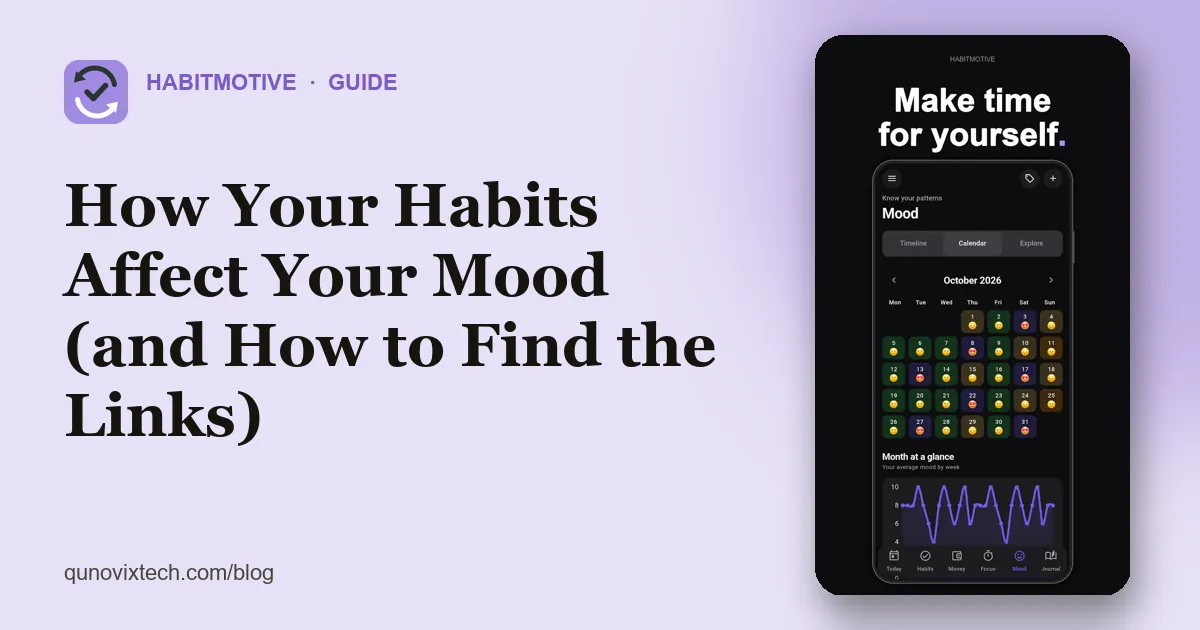
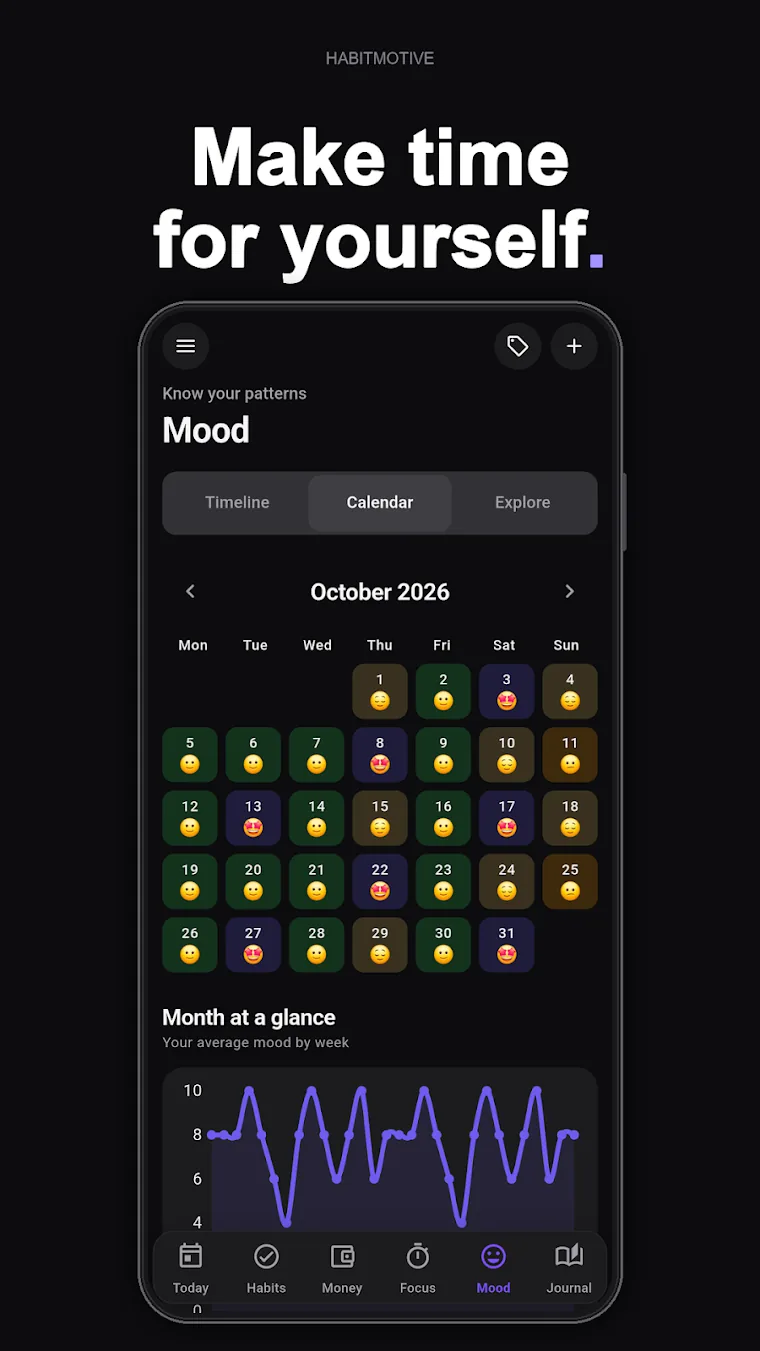
- Look at monthly trends. Calendar views and charts make patterns easier to spot.
Run small experiments
Once you spot a possible link, test it:
- Pick one habit. For example, a 15-minute walk after lunch.
- Do it for two weeks.
- Compare your average mood with the previous two weeks.
- Keep what helps. Drop what doesn't.
This turns vague advice ("exercise is good for you") into personal evidence.
What the data can't tell you
Correlation isn't causation. If your mood is higher on days you exercise, it might be that exercise lifts your mood, or that you exercise more on days you already feel good. Small experiments help separate the two.
Combining mood with journaling
Mood scores show what; journal entries show why. Writing a line or two on notable days adds context you'll appreciate later. See how to keep a mood journal for a detailed method.
All in one place
HabitMotive lets you record your mood with tags and notes, view a mood calendar and trends, and explore connections between your habits and how you feel, alongside your habit tracker and journal.
When to seek help
If you notice persistently low mood, loss of interest in things you usually enjoy, or thoughts of self-harm, please talk to a doctor or mental health professional. Habit and mood tracking is a helpful self-awareness tool, but not a substitute for professional support.
Key takeaways
- Sleep, movement, daylight, social contact, alcohol and screens are commonly linked with mood.
- Track mood daily with tags, alongside a few key habits.
- Review weekly and monthly, then test one change at a time.
- Remember correlation isn't causation, and seek help for persistent low mood.
Frequently asked questions
Can habits really change your mood?
Habits like sleep, physical activity and social contact are commonly linked with mood. Effects vary by person.
How do I track my mood?
Rate your mood once a day on a simple scale, add tags for context, and review the patterns weekly.
What's the best habit for improving mood?
There's no single best habit. Many people benefit from better sleep, regular movement and time outdoors. Tracking shows what works for you.
Can a mood tracker diagnose depression?
No. It can help you notice patterns to discuss with a professional, but it isn't a diagnostic tool.

We're an independent app studio in Pune, India. We build HabitMotive: Habit Tracker and write these guides from what we learn making it and from the questions our users send us. Spotted an error? Email qunovixtechnologies@gmail.com.