Missed a Day? How to Recover a Broken Habit Streak
Breaking a habit streak feels bad, but it doesn't erase your progress. Learn why one miss matters little, the never-miss-twice rule and how to restart.
- Why one missed day barely affects habit formation
- The "never miss twice" rule and how to use it
- How to plan for busy days so streaks survive
You've done your habit for 23 days straight, and then life gets in the way. The streak resets to zero, and suddenly it's tempting to give up entirely. Don't. A missed day is a normal part of building any habit.
One miss doesn't erase progress
In a well-known 2009 study on habit formation, Phillippa Lally and colleagues found that missing a single day didn't significantly affect how automatic a habit became over time. What matters is overall consistency, not a perfect record.
Your 23 days of practice still happened. The cue-behaviour link you built is still there.
The "never miss twice" rule
Popularised by writers like James Clear, the idea is simple: missing once is an accident; missing twice is the start of a new habit. Make the day after a miss a priority, even if you only do the smallest version.
Why broken streaks feel so bad
Streaks are motivating because they turn consistency into a visible number. The flip side is that losing one feels like losing everything. This "what the hell effect" (giving up entirely after one slip) is common with goals.
Reframe it: a streak is a tool, not the goal. The goal is the habit.
How to recover after a missed day
- Notice, don't judge. "I missed yesterday" is a fact, not a verdict on you.
- Find the reason. Travel? Illness? Too-big habit? Unclear cue?
- Do the minimum today. One push-up, one page, one minute.
- Adjust if needed. If the same thing keeps tripping you up, change the time, cue or size of the habit.
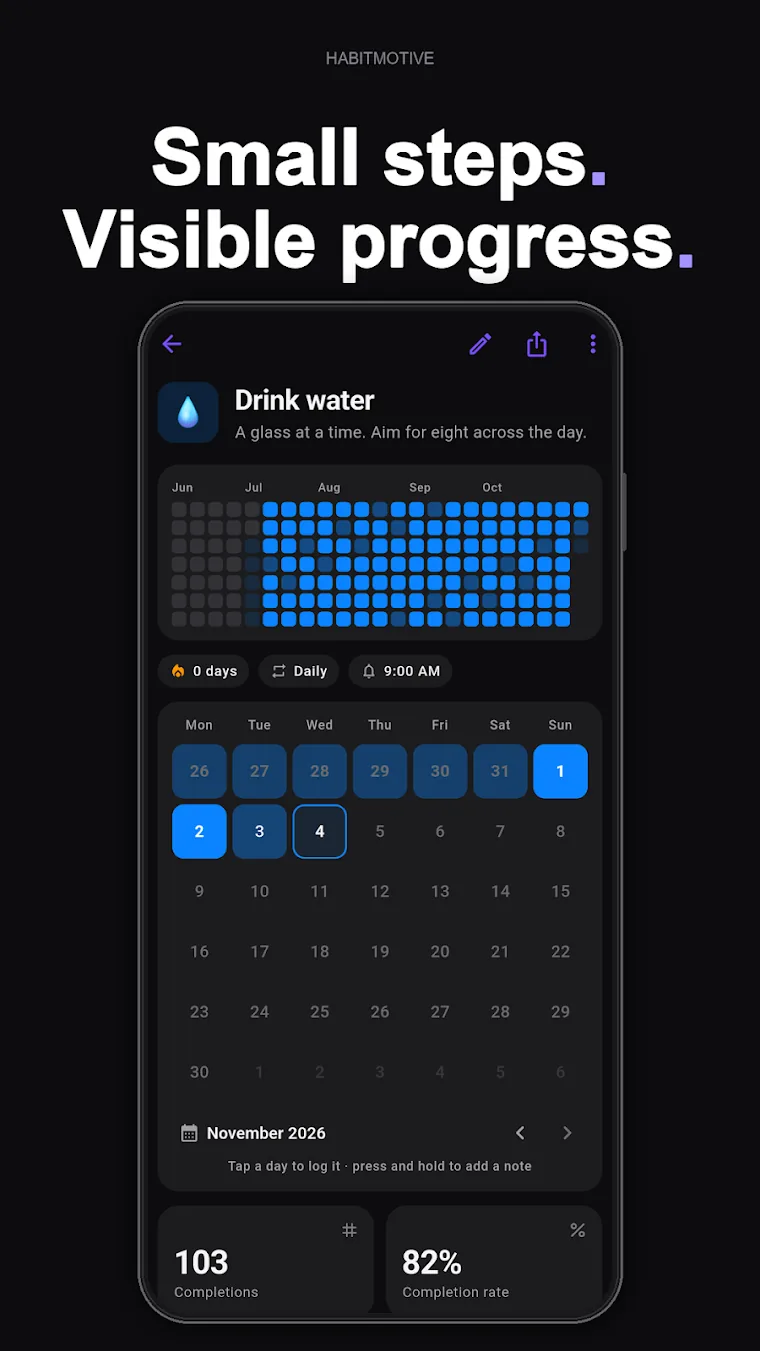
- Look at your heatmap, not your streak. Seeing mostly-filled weeks is more encouraging than a reset counter.
Plan for busy days in advance
| Situation | Minimum version |
|---|---|
| Travelling | Walk around the airport or hotel instead of the gym |
| Sick | Rest is the habit today; skip without guilt |
| Late night | Read one paragraph instead of ten pages |
| Busy morning | Two minutes of stretching instead of twenty |
| Festival or event | Log the habit as "flexible" or pause it |
Use flexible schedules
Not every habit needs to be daily. A workout three times a week, or a habit on weekdays only, is easier to sustain and reduces "failures" on rest days. HabitMotive supports flexible schedules, so a planned rest day doesn't break anything. It also shows completion rates and heatmaps alongside streaks.
When to restart completely
If you've missed a week or more, don't try to pick up where you left off at full intensity. Restart with the tiniest version, rebuild for a week, then grow it again. See how to build a habit.
Key takeaways
- One missed day doesn't significantly affect habit formation.
- Follow "never miss twice" and do the minimum version the next day.
- Look at overall consistency, like a heatmap, not just the streak number.
- Plan minimum versions and flexible schedules for busy days.
Frequently asked questions
Does missing one day ruin a habit?
No. Research suggests that missing a single day doesn't significantly affect habit formation.
What is the never miss twice rule?
If you miss a habit once, make sure you do it the next day so a single slip doesn't turn into a pattern.
Should I reset my streak if I miss a day?
Most trackers reset streaks automatically. Focus on completion rates and heatmaps to see your overall consistency.
How do I stay consistent when travelling?
Plan a minimum version of each habit that works anywhere, or use a flexible schedule.

We're an independent app studio in Pune, India. We build HabitMotive: Habit Tracker and write these guides from what we learn making it and from the questions our users send us. Spotted an error? Email qunovixtechnologies@gmail.com.