How to Get Better at Puzzle Games: 9 Habits of Strong Solvers
Want to solve puzzles faster and get stuck less? These nine habits of strong solvers, from pattern libraries to deliberate practice, work for any puzzle game.
- How strong solvers think differently from beginners
- Nine habits that make you better at any puzzle game
- How to practise deliberately instead of just playing more
Some people seem to see puzzle solutions instantly. That's rarely talent alone. It's usually a set of habits built over time. The good news is that these habits can be learned, and they work across arrow, block, sorting and logic puzzles.
1. Build a pattern library
Strong solvers recognise patterns: a queue of arrows, a staircase of nearly full lines, a bottle that's almost sorted. Each time you solve a tricky level, name the key idea. Over time, you'll spot it instantly.
2. Scan before you act
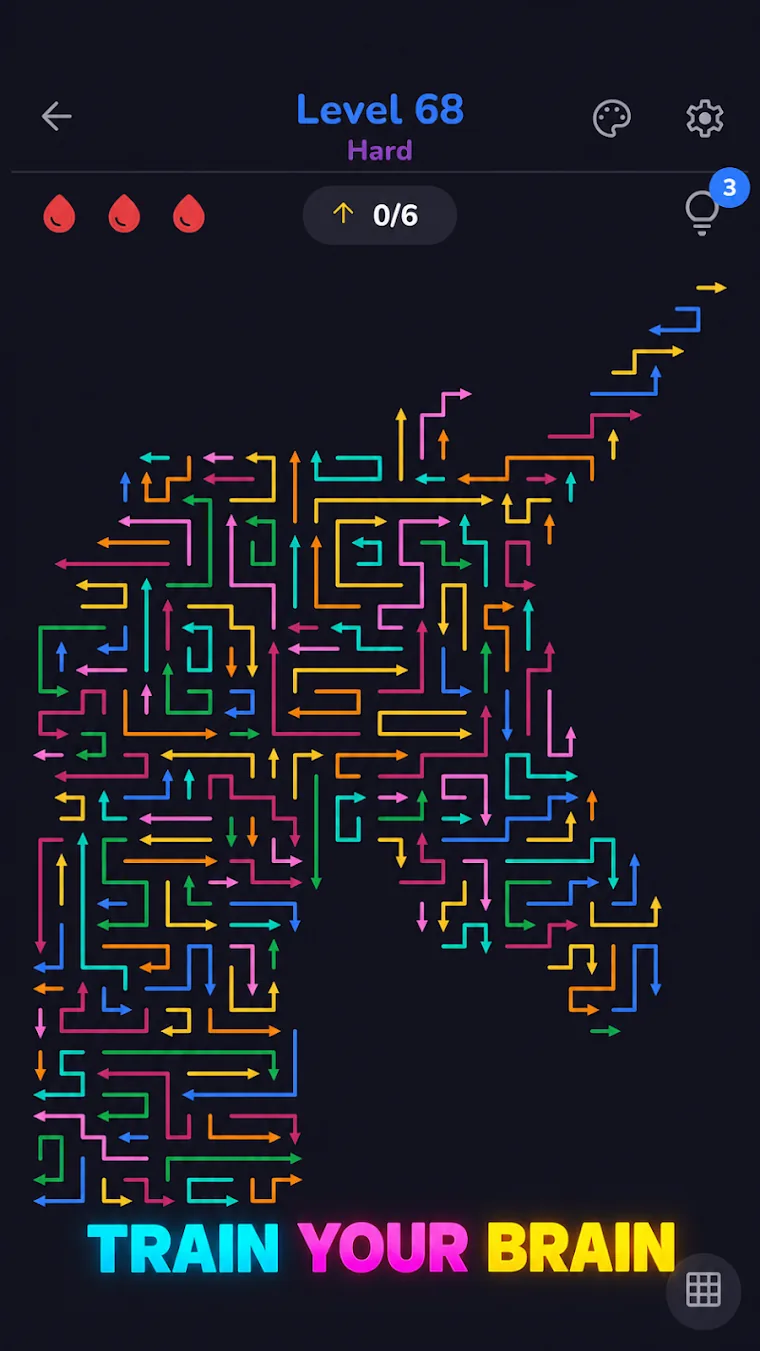
Beginners make the first move they see. Strong solvers scan the whole board first. In arrow puzzles, that means checking every edge. In block puzzles, every space where a piece could go.
3. Think a few moves ahead
Ask "what happens next?" before each move. Even one move of lookahead prevents many dead ends.
4. Work backwards
When stuck, imagine the solved state and work backwards. Which move must come last? Which before that? This is especially powerful in arrow puzzles.
5. Simplify big problems
Split large puzzles into regions or sub-goals. Solving smaller pieces one at a time is less overwhelming and often reveals the bigger solution.
6. Learn from every hint
If you use a hint, understand why it worked. A hint that teaches you a pattern is worth far more than one that just gets you past a level (see when to use hints).
7. Practise deliberately
Playing more helps, but deliberate practice helps more. Pick one skill to focus on per session, such as "scan the whole board every move," and concentrate on it.
8. Replay hard levels
Replaying a level you found difficult shows you how much you've learned, and cements the pattern.
9. Rest
Fatigue makes everyone worse at puzzles. Many solvers find that a solution "appears" after a break. Short sessions with rests beat long, tired sessions.
A simple practice plan
| Day | Focus |
|---|---|
| Mon | Scan the whole board before every move |
| Tue | Name the key pattern after each level |
| Wed | Replay two hard levels |
| Thu | Try working backwards on one stuck level |
| Fri | Play for fun, no focus |
Apply it to any puzzle game
- Arrow puzzles: Amaze Blast, with 10,000 levels to practise on.
- Block puzzles: Block Trails, where planning and space matter.
- Sorting puzzles: Color Flow, where sequencing is key.
Key takeaways
- Strong solvers build pattern libraries and scan before acting.
- Think ahead, work backwards and split big puzzles into parts.
- Learn from hints, practise deliberately and replay hard levels.
- Rest matters. Short, focused sessions beat long, tired ones.
Frequently asked questions
How can I get better at puzzle games?
Scan before you move, learn common patterns, think ahead, work backwards when stuck and practise deliberately.
Why do some people solve puzzles faster?
Usually because they recognise patterns from experience, not because of a special talent.
Does playing puzzle games make you better at them?
Yes, especially if you reflect on what you learned from each level.
How long should I practise puzzle games?
Short, focused sessions with breaks are more effective than long sessions.

We're an independent app studio in Pune, India. We build Amaze Blast: Arrow Puzzle and write these guides from what we learn making it and from the questions our users send us. Spotted an error? Email qunovixtechnologies@gmail.com.