When to Use Hints in Puzzle Games (Without Ruining the Fun)
Hints can rescue a frustrating level or spoil a great one. Learn when to use hints in puzzle games, how to use them well and what to try first.
- Why being stuck is part of the fun, up to a point
- Five things to try before using a hint
- How to use a hint so you still feel you solved the puzzle
Every puzzle player eventually hits a wall: a level you've stared at for ten minutes with no idea what to do. Hints exist for exactly this moment. Used well, they keep you playing. Used too early, they take away the satisfaction of solving.
Why being stuck is valuable
The "aha!" moment, when you suddenly see the answer, is what makes puzzles satisfying. That moment only comes after a little struggle. If you take a hint at the first sign of difficulty, you skip the best part.
But there's a limit. When frustration outweighs curiosity, the game stops being fun. That's when a hint is worth it.
Five things to try before using a hint
- Re-scan the whole board. The move you need is often far from where you've been looking.
- Work backwards. Ask what the last move could be, then the one before that.
- Simplify. Focus on one region or one piece at a time.
- Take a short break. Look away for a few minutes. Your brain keeps working in the background.
- Explain it out loud. Describing the problem often reveals the gap in your thinking.
How to use a hint well
- Take one hint, not several. Let it show you the next step, then continue yourself.
- Understand why. After a hint, ask why that move was right. You'll recognise the pattern next time.
- Save them for hard levels. Hints are limited in many games, so keep them for the toughest puzzles.
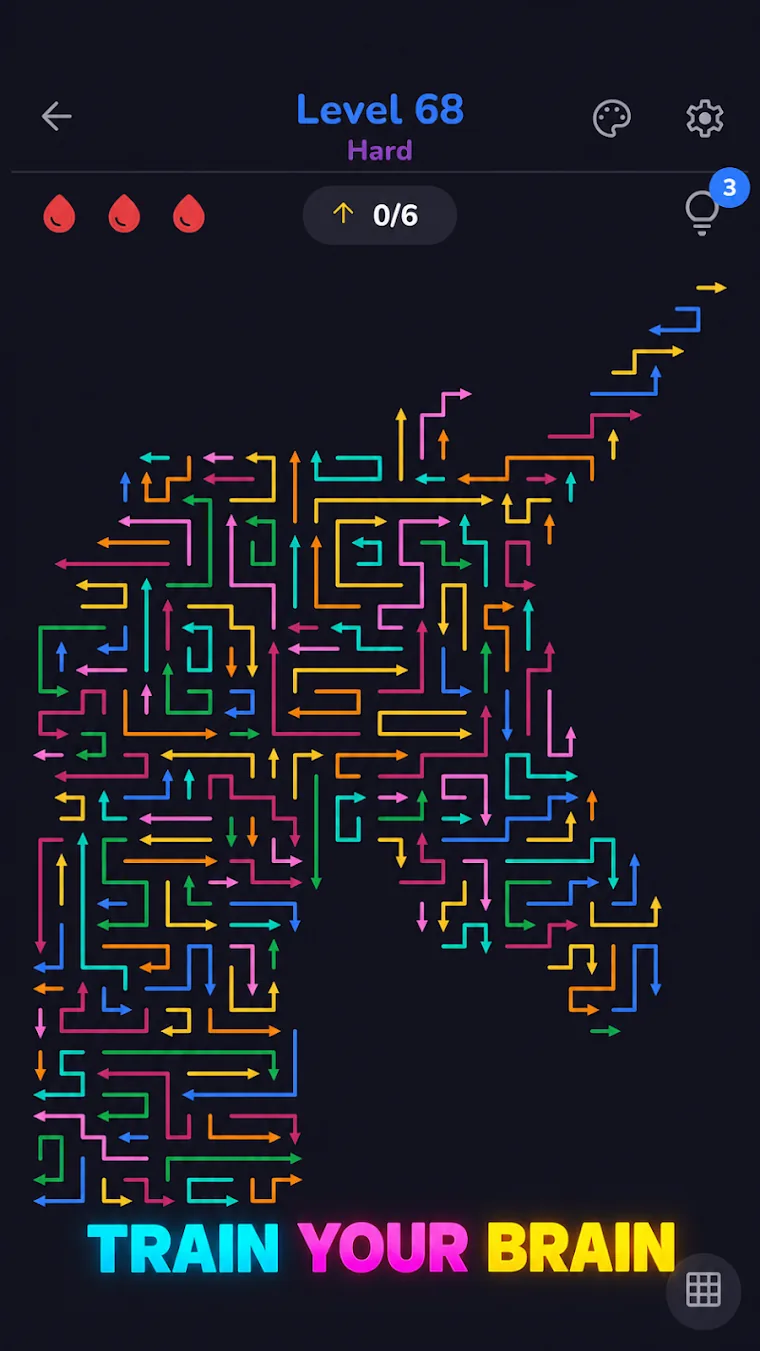
Hints in different puzzle types
| Game type | What a hint usually shows | Try first |
|---|---|---|
| Arrow puzzles | An arrow that can be cleared | Check edges and dependency chains |
| Block puzzles | A good placement | Check room for big pieces |
| Water sort | A useful pour | Look for empty bottles and matching tops |
| Word puzzles | A letter or word | Try different starting letters |
For arrow puzzles specifically, our arrow puzzle strategy covers dependency chains and working backwards.
Hints vs undo
- Undo helps you recover from a mistake you've already made.
- Hints help you find a move you can't see.
In games that offer both, use undo for "oops" moments and hints for genuine stuck moments.
Is using hints cheating?
No. It's a single-player game designed with hints for a reason. The goal is to enjoy it. If a hint keeps you playing instead of quitting, it's doing its job.
Amaze Blast includes hints for tricky mazes, with no timers, so you can choose when you need one.
Key takeaways
- Some struggle makes solving satisfying. Don't reach for hints too early.
- Re-scan, work backwards, simplify and take a break first.
- Take one hint at a time and understand why it works.
- Hints aren't cheating. They're there to keep the game enjoyable.
Frequently asked questions
Is it bad to use hints in puzzle games?
No. Hints are designed to help when you're stuck. Just try a few strategies first so you still enjoy solving.
How can I get better without hints?
Learn common patterns for your game type, practise regularly and review why a solution worked.
What's the difference between a hint and undo?
Undo reverses your last move. A hint suggests a good next move.
Why do I get stuck on puzzles that look easy?
Puzzles often hide the key move in an unexpected place. Scanning the whole board and working backwards help.

We're an independent app studio in Pune, India. We build Amaze Blast: Arrow Puzzle and write these guides from what we learn making it and from the questions our users send us. Spotted an error? Email qunovixtechnologies@gmail.com.