How Long Does It Take to Form a Habit? What the Research Says
Is it really 21 days? We look at what research says about how long it takes to form a habit, why it varies so much and how to speed up the process.
- Where the "21 days" myth came from
- What studies have found about habit formation time
- Factors that make a habit form faster or slower
"It takes 21 days to form a habit" is one of the most repeated pieces of self-help advice. Unfortunately, research doesn't support it. The real answer is usually longer, and more variable.
Where the 21-day idea came from
The idea is often traced to Dr Maxwell Maltz's 1960 book Psycho-Cybernetics. Maltz observed that patients seemed to take a minimum of about 21 days to adjust to changes, such as a new appearance after surgery. Over time, "a minimum of about 21 days" became "21 days" in popular retellings.
What research found
The most cited study is by Phillippa Lally and colleagues at University College London, published in 2009. Participants chose a new daily eating, drinking or exercise behaviour and reported how automatic it felt each day.
Key findings:
- The median time to reach maximum automaticity was about 66 days.
- The range was huge: from 18 to 254 days, depending on the person and the habit.
- Missing a day now and then didn't significantly derail habit formation.
- Simpler habits (like drinking water) tended to become automatic faster than complex ones (like doing sit-ups).
A later review of habit studies, published in 2024, also found wide variation, with many habits taking around two months or more to form.
Why it varies so much
| Faster | Slower |
|---|---|
| Simple behaviours | Complex or effortful behaviours |
| Clear, consistent cue | Vague or changing cue |
| Same time and place daily | Irregular schedule |
| Immediately rewarding | Delayed rewards |
| Done daily | Done occasionally |
How to help a habit form faster
- Keep it simple. The smaller the behaviour, the faster it becomes automatic.
- Use a consistent cue. Same time, same place, after the same routine. See habit stacking.
- Repeat daily. Frequency builds automaticity.
- Make it rewarding. Tick it off, enjoy the streak, notice how you feel.
- Don't panic over missed days. Research suggests the occasional miss isn't a disaster.
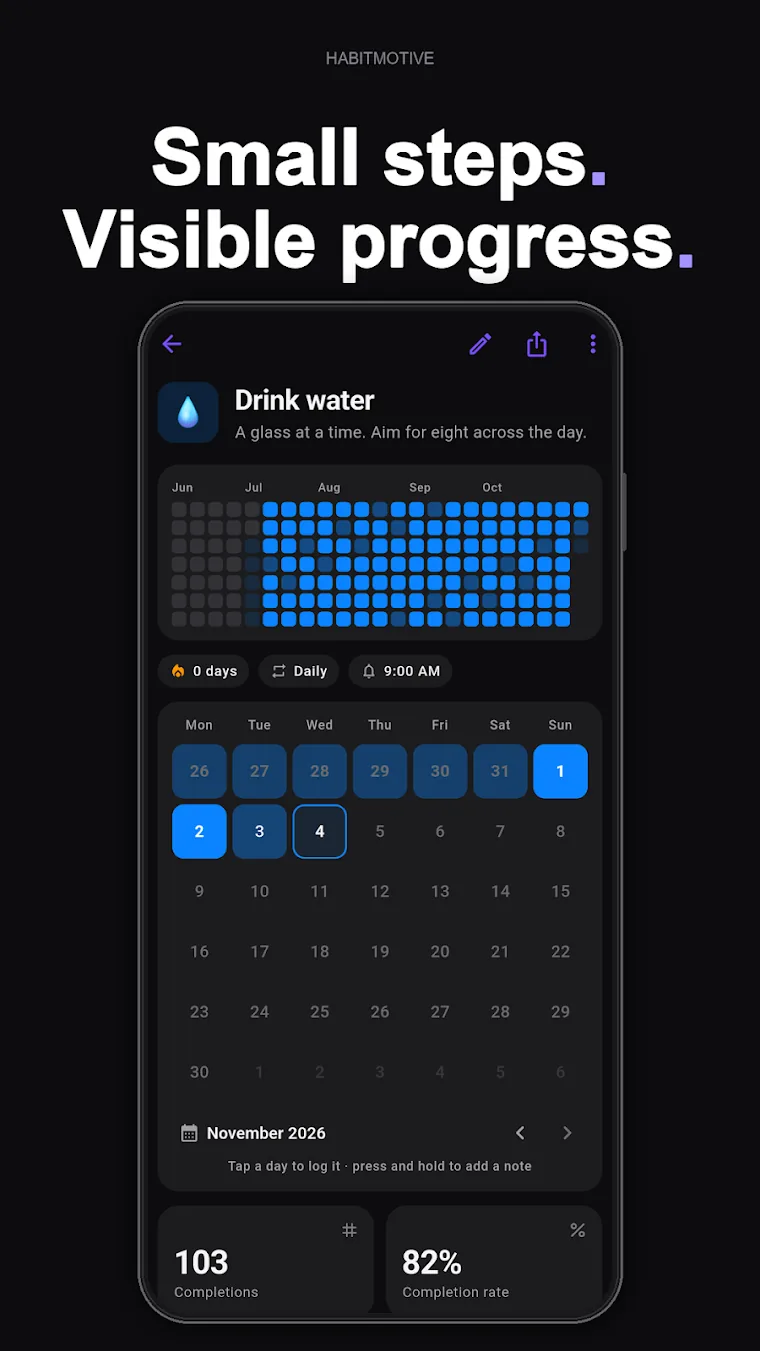
Focus on consistency, not a deadline
Instead of counting down to an arbitrary day, look at consistency. A heatmap or calendar view shows whether you're doing the habit on most days, which is what matters. HabitMotive shows streaks, heatmaps and completion rates for each habit.
Signs a habit is becoming automatic
- You start doing it without consciously deciding.
- Skipping it feels strange.
- It takes less effort to begin.
- You notice the cue and the behaviour follows naturally.
Key takeaways
- The 21-day rule comes from a misreading of a 1960 book.
- A well-known study found a median of about 66 days, ranging from 18 to 254.
- Simple, daily habits with clear cues form faster.
- Occasional missed days don't ruin habit formation.
Frequently asked questions
Is 21 days enough to form a habit?
For some simple habits it might be, but research suggests it usually takes longer, often around two months.
What is the 66-day rule?
It refers to the median time participants took to form a habit in Lally's 2009 study. Individual times ranged from 18 to 254 days.
Does missing a day reset habit formation?
The 2009 study found that missing a single day didn't significantly affect the process.
How do I know when a habit is formed?
When you do it with little thought or effort, and skipping it feels odd.

We're an independent app studio in Pune, India. We build HabitMotive: Habit Tracker and write these guides from what we learn making it and from the questions our users send us. Spotted an error? Email qunovixtechnologies@gmail.com.