The Pomodoro Technique: How to Use It (and Make It Work for You)
The Pomodoro Technique uses 25-minute focus sessions and short breaks. Learn how it works, how to adapt the timings and how to track your sessions.
- How the classic Pomodoro Technique works
- How to adapt session lengths to your work
- How to track focus sessions and protect them from interruptions
The Pomodoro Technique is one of the simplest focus methods there is: work for a short, fixed time, then take a short break. It's popular because it makes starting easier and helps prevent burnout during long tasks.
Where it comes from
Francesco Cirillo developed the technique in the late 1980s as a university student. He used a tomato-shaped kitchen timer, and pomodoro is Italian for tomato.
How the classic technique works
- Pick one task. Be specific: "Write the introduction," not "work on the report."
- Set a timer for 25 minutes. This is one "pomodoro."
- Work only on that task. If a distraction comes up, note it down and return to the task.
- Take a 5-minute break. Stand up, stretch, get water.
- Repeat. After four pomodoros, take a longer break of 15–30 minutes.
Why it works
- Easier to start. "Just 25 minutes" feels manageable, even for tasks you've been avoiding.
- Built-in breaks. Regular rests can help reduce mental fatigue.
- Awareness of time. Counting pomodoros shows how long tasks really take.
- Fewer interruptions. A clear focus window makes it easier to say "not now."
Adapting the timings
25/5 is a starting point, not a rule.
| Style | Focus | Break | Suits |
|---|---|---|---|
| Classic | 25 min | 5 min | Most tasks, getting started |
| Short | 15 min | 3–5 min | Low energy, ADHD-friendly starts, kids' homework |
| Long | 45–50 min | 10 min | Deep work, writing, coding |
| Extended | 60–90 min | 15–20 min | Very deep, uninterrupted work |
Experiment for a week and keep what feels sustainable.
Handling interruptions
- Internal (your own thoughts): write them down on a "later" list and return to the task.
- External (people, messages): silence notifications, close chat apps and, if possible, tell people you'll reply after the session.
- Unavoidable: stop the timer, deal with it, and restart a fresh session.
How to run a focus session
- Choose your task and length. For example, 25 minutes on one specific task.
- Remove distractions. Phone on Do Not Disturb, extra tabs closed.
- Start the timer. Begin immediately, no warm-up scrolling.
- Note distractions. Write them down rather than acting on them.
- Stop when the timer ends. Take the break, even if you're in flow (or extend once, deliberately).
- Log the session. Track how many sessions you complete each day.
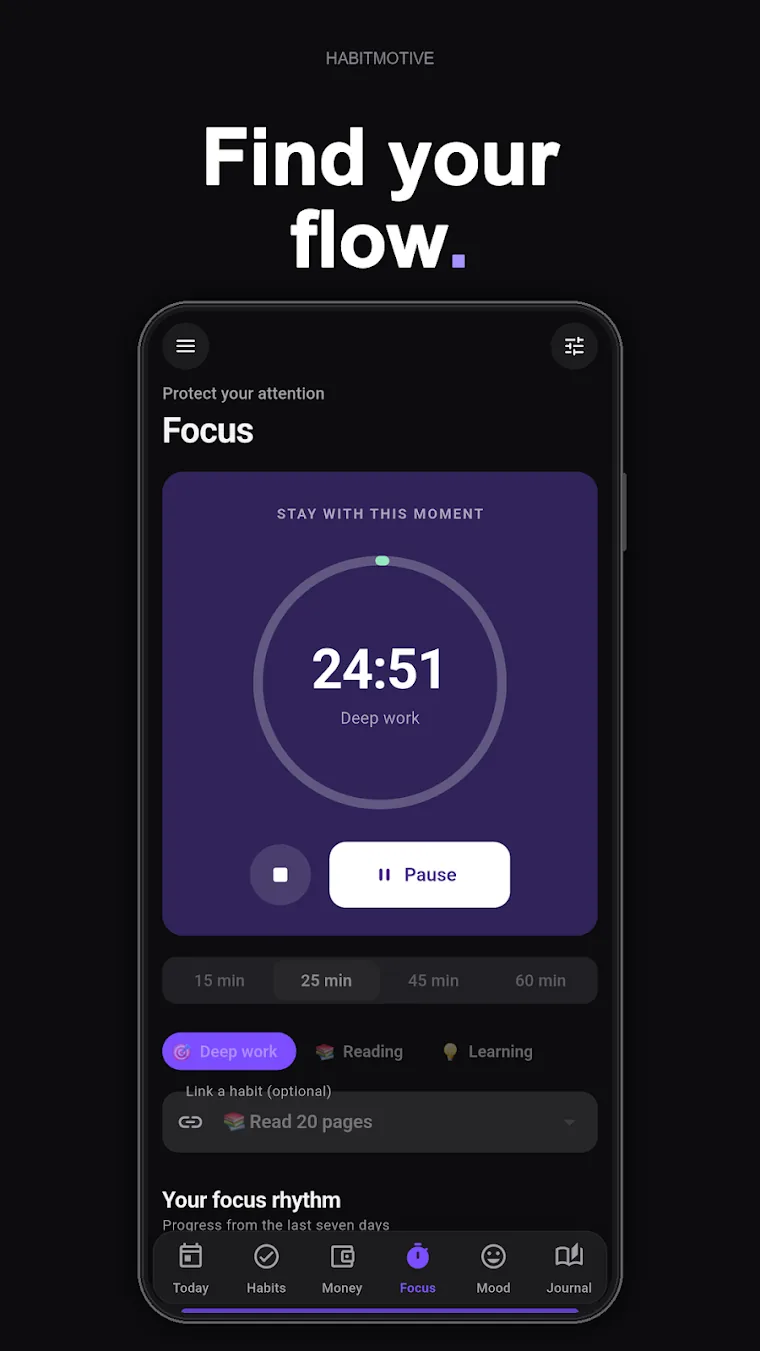
Track your focus
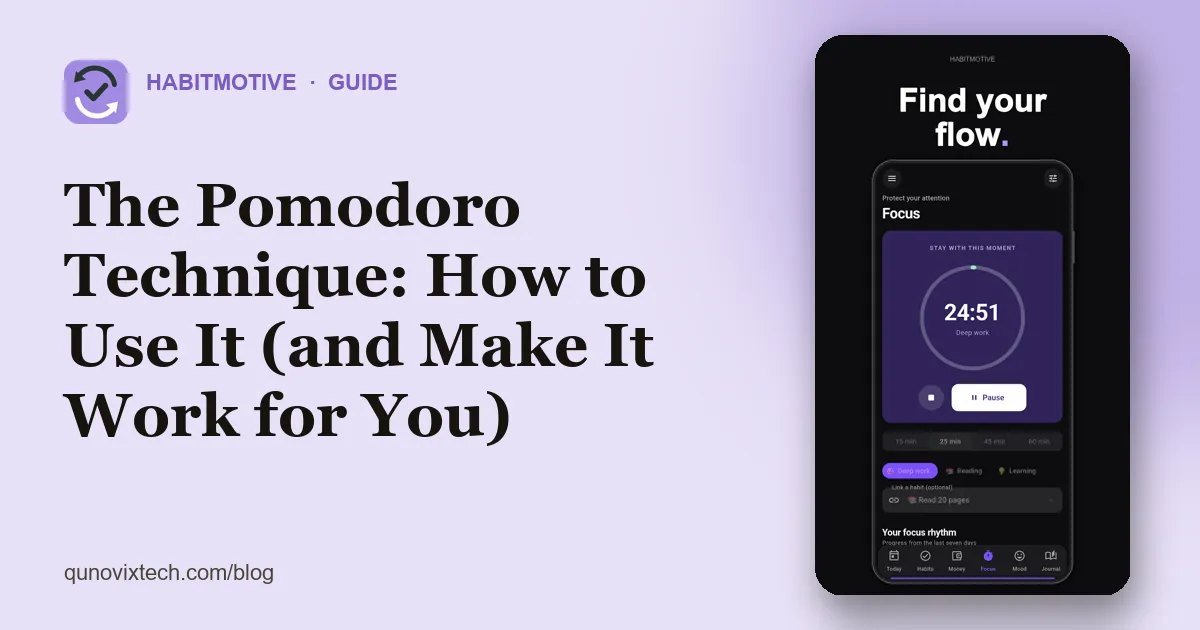
HabitMotive includes a Pomodoro timer with adjustable lengths. You can link focus sessions to habits (like "study 1 hour"), set goals and review your session history over time.
Common pitfalls
- Skipping breaks. Breaks are part of the method, not a reward you can skip.
- Vague tasks. "Work" isn't a task. Be specific.
- Checking the phone on breaks. It often turns a 5-minute break into 20. Move your body instead.
- Rigid timings. If 25 minutes doesn't suit you, change it.
For more ways to beat procrastination, read how to build a habit.
Key takeaways
- Work for 25 minutes, break for 5, and take a longer break after four sessions.
- Pick one specific task per session and silence distractions.
- Adjust timings to your energy and type of work.
- Log sessions to see your focus improve over time.
Frequently asked questions
What is the Pomodoro Technique?
A time management method where you work for 25 minutes, take a 5-minute break, and take a longer break after four sessions.
Is 25 minutes the best length?
It's a good starting point. Many people use longer sessions for deep work or shorter ones on low-energy days.
What should I do during Pomodoro breaks?
Stand up, stretch, drink water or look away from screens. Avoid scrolling, which tends to stretch the break.
Does the Pomodoro Technique work for studying?
Yes. Many students use it to break study into focused chunks with regular rests.

We're an independent app studio in Pune, India. We build HabitMotive: Habit Tracker and write these guides from what we learn making it and from the questions our users send us. Spotted an error? Email qunovixtechnologies@gmail.com.