How to Estimate Body Fat Percentage at Home (and How Accurate It Is)
Curious about your body fat percentage? Compare home methods, from BMI formulas and tape measurements to smart scales, and see how accurate each one is.
- Why body fat percentage tells you more than weight alone
- How BMI-based and tape-measure formulas estimate body fat
- How accurate home methods are, and how to use them sensibly
Two people can weigh the same but look and feel very different, because one carries more muscle and the other more fat. Body fat percentage captures that difference. Measuring it precisely needs specialist equipment, but you can estimate it at home.
Why body fat percentage matters
Weight alone doesn't separate fat from muscle, water and bone. Body fat percentage gives a better sense of body composition. Tracking an estimate over time can show you're losing fat even when your weight changes slowly.
Home methods compared
| Method | How it works | Accuracy | Effort |
|---|---|---|---|
| BMI-based formula | Uses BMI, age and sex | Rough estimate | Very low |
| Tape measurements (e.g. US Navy method) | Uses waist, neck (and hips for women) and height | Moderate for many people | Low |
| Smart scale (bioelectrical impedance) | Sends a small current through the body | Varies with hydration | Very low |
| Skinfold calipers | Measures skin folds at set sites | Good with practice | Medium |
| DEXA scan (clinic) | Low-dose X-ray scan | High | Needs a clinic |
BMI-based estimates
One widely cited formula, published by Deurenberg and colleagues in 1991, estimates adult body fat from BMI, age and sex:
Body fat % ≈ (1.20 × BMI) + (0.23 × age) − (10.8 × sex) − 5.4 where sex = 1 for men and 0 for women.
Example: a 35-year-old woman with a BMI of 25.6: (1.20 × 25.6) + (0.23 × 35) − 0 − 5.4 ≈ 30.7 + 8.05 − 5.4 ≈ 33%
This is quick but rough, because it inherits BMI's limits. It tends to overestimate body fat in muscular people and may underestimate it in people with low muscle mass. See is BMI accurate? for more.
Tape-measure methods
The US Navy method uses neck and waist circumference (plus hips for women) with height. It's often more accurate than BMI-based formulas for people with more muscle, and all you need is a flexible tape measure.
Smart scales
Smart scales estimate body fat using bioelectrical impedance. Readings can change noticeably with hydration, meals, exercise and time of day. If you use one, measure under the same conditions every time and look at trends rather than single readings.
How to use body fat estimates sensibly
- Pick one method and stick with it. Different methods give different numbers. Compare like with like.
- Measure under the same conditions. Same time of day, same hydration.
- Track the trend monthly. Small changes week to week are mostly noise.
- Combine with other measures. Use alongside waist measurements and progress photos.
- Talk to a professional if you need an accurate measurement for health reasons.
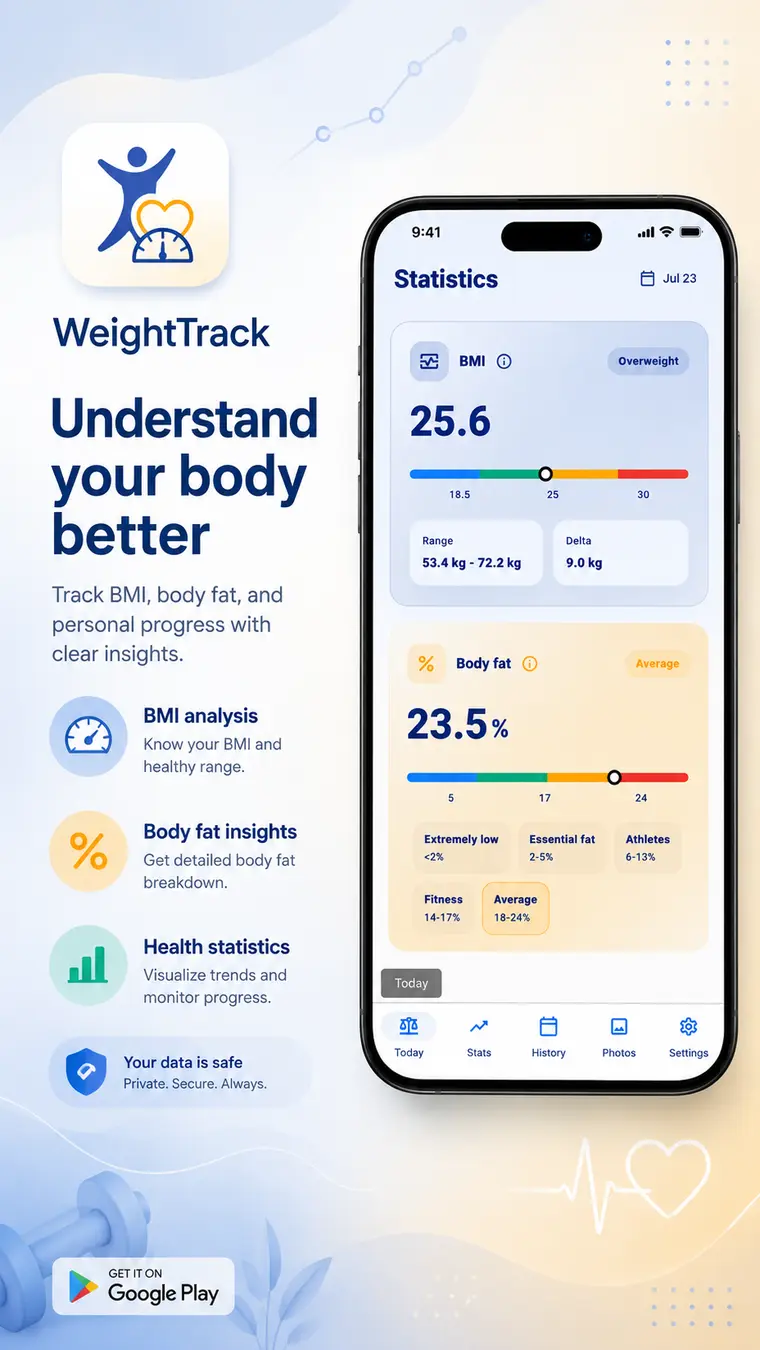
WeightTrack shows a body fat estimate alongside BMI in its statistics, so you can follow the trend over time without extra tools. Treat it as an estimate, and focus on the direction it moves.
Key takeaways
- Body fat percentage separates fat from other weight.
- BMI-based formulas are quick but rough. Tape-measure methods can be more accurate for many people.
- Smart scale readings vary with hydration, so use consistent conditions.
- Track one method's trend over months and combine it with other measures.
Frequently asked questions
What's the most accurate way to measure body fat at home?
Tape-measure methods and skinfold calipers (with practice) are usually more accurate than BMI-based formulas. A DEXA scan in a clinic is more accurate still.
How accurate are BMI-based body fat calculators?
They give a rough estimate. They can be misleading for muscular people, older adults and some ethnic groups.
Why does my smart scale body fat change every day?
Bioelectrical impedance is affected by hydration, meals and exercise. Measure at the same time each day and watch the trend.
How often should I check my body fat percentage?
Monthly is enough. Body composition changes slowly.

We're an independent app studio in Pune, India. We build WeightTrack: Weight Tracker and write these guides from what we learn making it and from the questions our users send us. Spotted an error? Email qunovixtechnologies@gmail.com.