BMI vs Body Fat Percentage: What's the Difference?
BMI and body fat percentage measure different things. Learn how each works, when they disagree, healthy body fat ranges and which one to track for your goals.
- What BMI and body fat percentage each measure
- Why the two can disagree, with examples
- Which one to track depending on your goals
BMI and body fat percentage are often mentioned together, but they're not the same thing. BMI compares weight to height. Body fat percentage estimates how much of your weight is fat. Understanding the difference helps you interpret both.
Side-by-side comparison
| BMI | Body fat percentage | |
|---|---|---|
| What it measures | Weight relative to height | Proportion of body weight that is fat |
| What you need | Height and weight | Specialist equipment, measurements or estimates |
| Cost and effort | Free, seconds | Free (estimates) to expensive (DEXA) |
| Separates fat from muscle? | No | Yes |
| Accuracy for individuals | Rough screening | Depends on method |
| Used for | Population screening, quick checks | Body composition, fitness goals |
Why they can disagree
Because BMI uses total weight, it can't tell muscle from fat:
- A muscular person may have a BMI in the overweight range but low body fat.
- Someone with low muscle mass may have a normal BMI but relatively high body fat. This is sometimes called "normal weight obesity."
- Older adults often lose muscle with age, so the same BMI can mean more body fat than at a younger age.
Typical body fat ranges
Body fat ranges vary between sources and with age, but many guides use approximate bands like these for adults:
| Men | Women | |
|---|---|---|
| Essential fat | 2–5% | 10–13% |
| Athletic | 6–13% | 14–20% |
| Fitness | 14–17% | 21–24% |
| Average | 18–24% | 25–31% |
| Higher | 25%+ | 32%+ |
Women naturally carry more essential fat than men, related to reproductive health. These ranges are general guides, not medical targets.
How body fat is measured
From most to least accurate, roughly:
- DEXA scans and other clinical methods.
- Skinfold calipers used by a trained person.
- Tape-measure formulas, such as the US Navy method.
- Smart scales (bioelectrical impedance), which vary with hydration.
- BMI-based formulas, which estimate body fat from BMI, age and sex.
Our WeightTrack guide covers how to estimate body fat percentage at home in more detail.
Which should you track?
- For a quick health screen: BMI, combined with waist size.
- For fitness or strength training: body fat percentage or measurements, because BMI won't reflect muscle gain.
- For weight loss: both, plus waist measurements and progress photos.
A practical combination
- Check your BMI. It's a quick reference point. See how to calculate BMI.
- Measure your waist. Compare it to half your height (see waist-to-height ratio).
- Estimate body fat occasionally. Use the same method each time.
- Track trends monthly. Direction matters more than any single number.
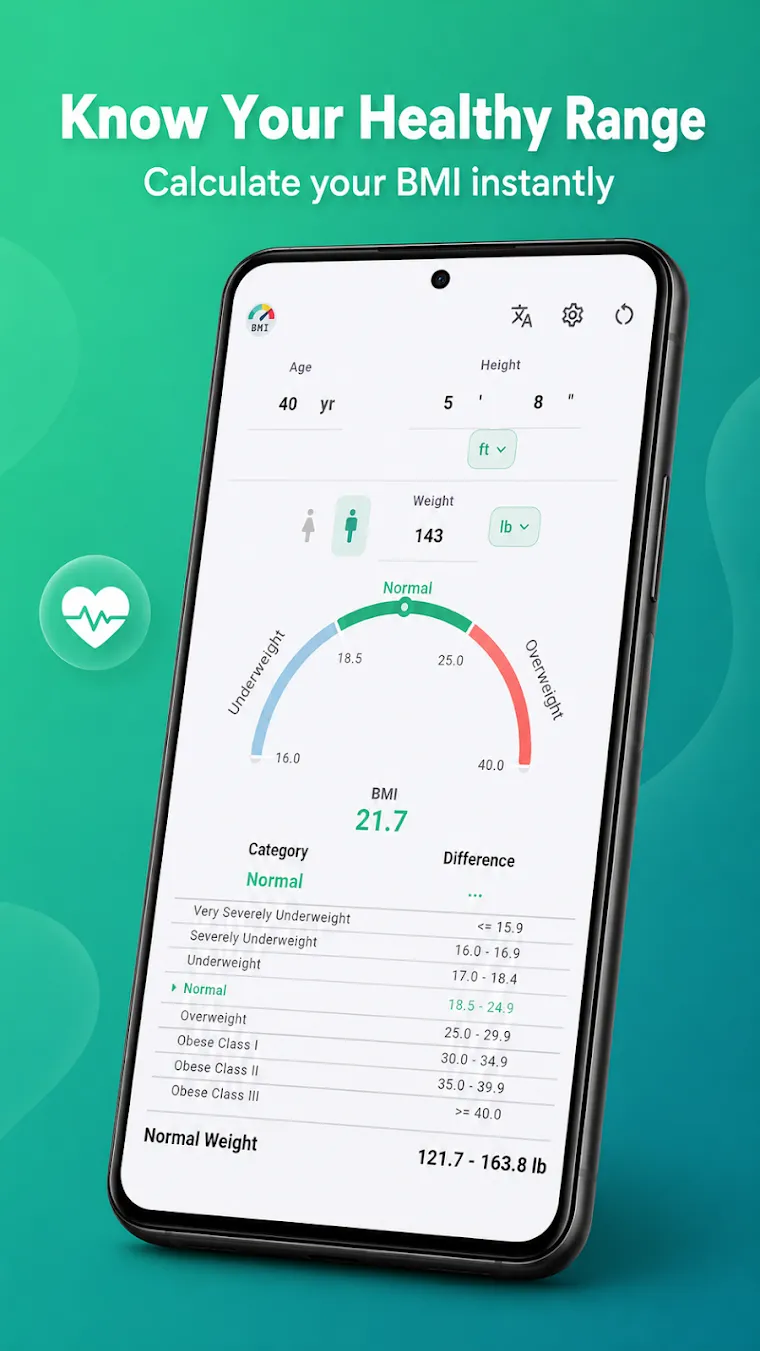
BMI Calculator gives you an instant BMI and healthy range as a starting point. If you track weight over time, WeightTrack adds a body fat estimate and trend charts.
Key takeaways
- BMI measures weight relative to height. Body fat percentage estimates how much of that weight is fat.
- They can disagree for muscular people, older adults and people with low muscle.
- Use BMI for quick screening and body fat for body composition goals.
- Combine both with waist size for the clearest picture.
Frequently asked questions
Is body fat percentage more accurate than BMI?
It gives more information about body composition, but home estimates vary in accuracy. BMI is simpler and more consistent.
Can I have a normal BMI and high body fat?
Yes. People with low muscle mass can have a normal BMI but relatively high body fat.
What is a healthy body fat percentage?
It varies by age and sex. Many guides consider roughly 14–24% healthy for men and 21–31% for women, but these are general ranges.
Should athletes use BMI?
BMI often overestimates fatness in athletes. Body fat percentage or measurements are usually more useful.

We're an independent app studio in Pune, India. We build BMI Calculator and write these guides from what we learn making it and from the questions our users send us. Spotted an error? Email qunovixtechnologies@gmail.com.