15 English Learning Games for Kids at Home (No Prep Needed)
Fun, no-prep English learning games for young kids at home: vocabulary, listening, phonics and speaking games you can play anywhere with everyday objects.
- Fifteen no-prep games for vocabulary, listening and speaking
- Which games suit toddlers and which suit older preschoolers
- How to adapt games for children learning English as a second language
Children learn best when they're having fun. These 15 English learning games need no special materials, just everyday objects and a bit of imagination.
Vocabulary games
1. What's in the bag?
Put a few objects in a bag. Your child pulls one out and names it.
2. I spy
"I spy with my little eye something that is red." For younger children, use colours. For older ones, use first sounds: "something beginning with b."
3. Picture match
Point to a picture in a book and find the real object in the room.
4. Kim's game
Show 5 objects, cover them, remove one, and ask what's missing.
5. Category game
"Name an animal… a fruit… something in the kitchen."
Listening games
6. Simon says
"Simon says touch your nose." Great for body parts and action words.
7. Follow the instruction
"Put the ball under the chair." Teaches prepositions like in, on, under and next to.
8. Animal sounds
"Which animal says moo?" Then switch: you make the sound, they name the animal.
9. Freeze dance
Play music and call out an action word when it stops: jump, sit, spin.
Phonics and rhyming games
10. Rhyme time
"What rhymes with cat?" Hat, mat, bat, even made-up words count.
11. Sound hunt
Pick a sound like "b" and find things that start with it (see phonics for kids).
12. Clap the syllables
Clap each part of a word: ba-na-na (3 claps).
Speaking games
13. Shop pretend
Set up a pretend shop: "Can I have two apples, please?" Practise numbers and polite words.
14. Tell me a story
Take turns adding one sentence to a story.
15. Describe and guess
Describe an object without naming it: "It's yellow and long and you peel it." (Banana!)
Games by age
| Age | Good games |
|---|---|
| 2–3 years | What's in the bag, animal sounds, Simon says (simple), picture match |
| 3–4 years | I spy (colours), freeze dance, follow the instruction, category game |
| 4–5 years | I spy (sounds), rhyme time, Kim's game, describe and guess, story game |
Tips for children learning English as a second language
- Mix in the home language when explaining rules.
- Repeat key words many times in the same game.
- Use gestures and real objects.
- Praise attempts, not just correct answers.
Screen and offline balance
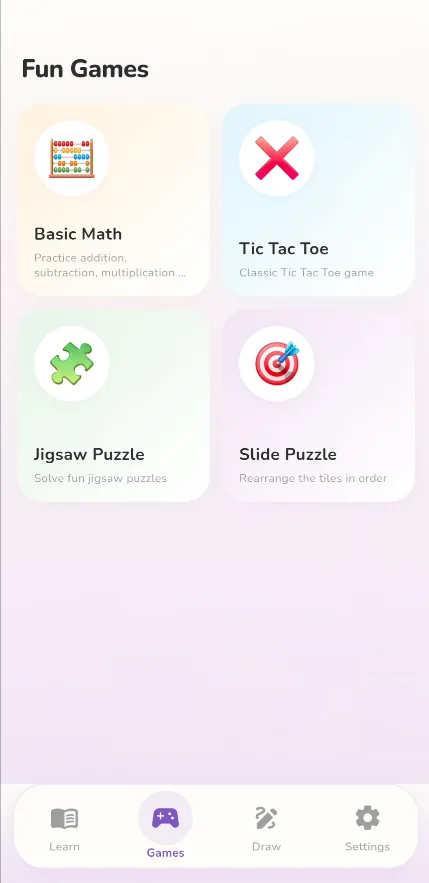
KidsEnglish includes games like basic maths, jigsaw puzzles, slide puzzles and Tic Tac Toe, plus drawing and colouring. Use them alongside the offline games above, within healthy screen time guidelines.
Key takeaways
- Games teach vocabulary, listening, phonics and speaking without feeling like lessons.
- Use everyday objects: no special materials needed.
- Choose games that match your child's age and level.
- For second-language learners, repeat words, use gestures and praise attempts.
Frequently asked questions
What are good English games for toddlers?
What's in the bag, animal sounds, picture matching and simple Simon says.
How can I teach English to my child at home?
Play language games, read picture books, sing songs and name objects during daily routines.
Are games better than worksheets for young children?
For young children, playful learning is usually more engaging and effective than worksheets.
How long should learning games last?
Ten to fifteen minutes is plenty for young children. Stop while they're still having fun.

We're an independent app studio in Pune, India. We build Kids English and write these guides from what we learn making it and from the questions our users send us. Spotted an error? Email qunovixtechnologies@gmail.com.