How to Teach Colours and Shapes to Toddlers (15 Easy Activities)
Teach colours and shapes through play with 15 easy activities using everyday objects, plus the order to introduce them and what's typical at each age.
- Which colours and shapes to teach first
- Fifteen simple activities using everyday objects
- How to tell if your child is ready for the next step
Colours and shapes are among the first concepts children learn, and they're easy to teach through everyday play. Here's how to introduce them, step by step.
What's typical by age
| Age | Colours | Shapes |
|---|---|---|
| 18–24 months | Matching colours (putting red with red) | Fitting shapes in a shape sorter |
| 2–3 years | Naming a few colours | Naming circle, square, triangle |
| 3–4 years | Naming most basic colours | More shapes: rectangle, star, heart, oval |
Matching comes before naming. A child who can sort red blocks from blue ones is learning, even if they can't say "red" yet.
Which to teach first
Colours: start with red, blue and yellow, then green, then others like orange, purple, pink, black and white.
Shapes: start with circle, square and triangle, then rectangle, star and heart.
Teach one or two at a time, and contrast very different ones (red vs blue, circle vs triangle).
8 colour activities
- Colour sorting. Sort blocks, toys or socks by colour.
- Colour of the day. Wear it, eat it, find it.
- Colour hunt. "Can you find something blue?"
- Fruit and vegetable colours. Red tomato, yellow banana, green peas.
- Mixing paints. Mix blue and yellow to make green.
- Coloured cups and balls. Put each ball in the matching cup.
- Car colours. Name the colours of cars on a walk.
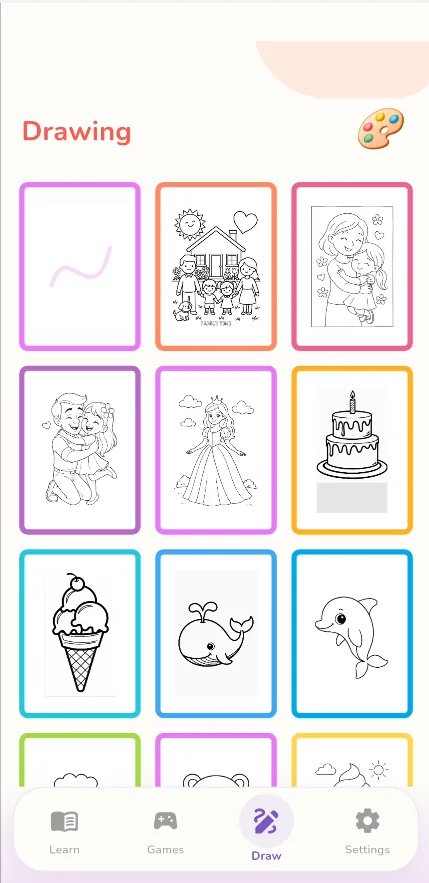
- Colouring pages. Talk about each colour as your child uses it.
7 shape activities
- Shape sorters. The classic toy for a reason.
- Shape hunts. Round clock, square window, triangle roof.
- Snack shapes. Cut sandwiches or chapatis into shapes.
- Playdough cutters. Press out shapes and name them.
- Draw shapes together. Trace circles and squares.
- Shape pictures. Build a house from a square and triangle.
- Shape puzzles. Jigsaw-style shape boards.
Teaching tips
- Use the word with the object: "a red ball," not just "red."
- Repeat across the day: colours and shapes are everywhere.
- Don't quiz constantly. Model the words more than you test them.
- Mix in other languages. In bilingual homes, use both languages naturally.
When to check with a professional
Some children have difficulty telling certain colours apart because of colour vision deficiency, especially boys. If your child consistently confuses particular colours (often red and green), mention it to your doctor.
Learning with KidsEnglish
KidsEnglish includes colours and shapes categories where children tap to hear each word, plus drawing and colouring pages. For more early vocabulary, see first English words for kids and the benefits of colouring.
Key takeaways
- Matching comes before naming, and both are progress.
- Start with red, blue, yellow and circle, square, triangle.
- Use everyday objects, snacks, walks and art.
- Model words often and keep quizzing light.
Frequently asked questions
At what age do toddlers learn colours?
Many children start naming some colours between 2 and 3 years, though matching often begins earlier.
Which colours should I teach first?
Red, blue and yellow are good first colours because they're easy to tell apart.
How do I teach shapes to a 2-year-old?
Use shape sorters, find shapes around the house and name shapes during play.
What if my child keeps mixing up colours?
That's common while learning. If they consistently confuse certain colours, such as red and green, mention it to a doctor.

We're an independent app studio in Pune, India. We build Kids English and write these guides from what we learn making it and from the questions our users send us. Spotted an error? Email qunovixtechnologies@gmail.com.